
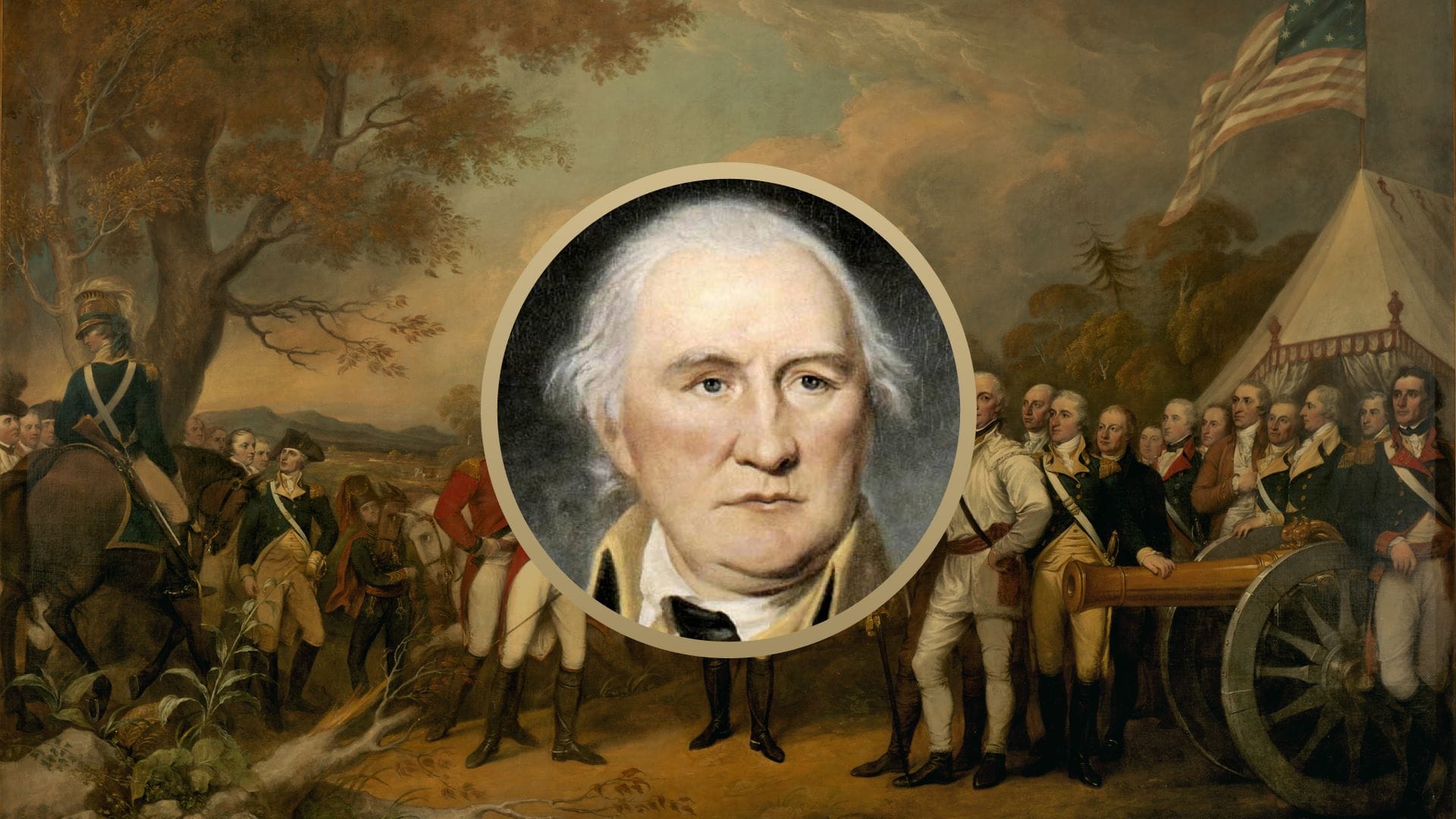
General Daniel Morgan rode along the lines of his men. His body was racked by the pain of rheumatism. He also suffered from sciatica, and every movement of his horse sent pain shooting up and down his spine. He endured other maladies from head to toe. All the teeth on the left side of his mouth had been shot away during the French and Indian War. As for his feet, one broken toe lay almost on top of his foot!
Still, despite the pain, General Morgan remained in active duty and a competent commander. He was known as “Old Wagoner” because his first military service involved the menial task of driving baggage wagons.
As Old Wagoner surveyed his men in the early morning light on January 17, 1781, he knew before him lay what would be the battle of his life. According to Isaiah 40:28–29, the prophet Isaiah spoke of the infinite power of God that equips weak men to accomplish mighty deeds: “Hast thou not known? hast thou not heard, that the everlasting God, the LORD, the Creator of the ends of the earth, fainteth not, neither is weary? there is no searching of his understanding. He giveth power to the faint; and to them that have no might he increaseth strength” (emphasis added).
Behind General Morgan’s little army rolled a turbulent stream known as the Broad River. Before him lay open fields. He knew that the British Legion commanded by the infamous Banastre Tarleton was soon to come down the road. The place where Morgan and his little company of men were was known as The Cowpens because cattle were held here before being taken to market. Here at The Cowpens, Old Wagoner Morgan would take his stand. He was determined to beat Tarleton here and thus save the homes and farms of the Carolinas from the marauding invaders.
Although Old Wagoner was now officially a general in the Continental army, he wore the same attire as his men wore: a rough, homespun hunting shirt; sturdy boots; and a broad-brimmed hat to protect the face from the elements. Morgan and his men, known as the Virginia Riflemen, and sometimes referred to as Morgan’s Riflemen, had fought everywhere in this War for American Independence. Famously, they had lost nowhere!
Morgan’s Riflemen had left their homes and farms in Virginia to answer the call to arms. They had been with Benedict Arnold on his difficult march through the wildernesses of Maine and Canada. They had fought gallantly at the Battle of Quebec. They had stood firm at the Battle of Saratoga and contributed nobly to that important victory.
Now, Morgan’s Riflemen had come southward to resist the invasion of the British army under Lord Charles Cornwallis. On this January day, the situation was very bleak for the patriot cause in South Carolina. Cornwallis had taken Charleston, South Carolina, and Savannah, Georgia, and all the strong military positions were held now in British hands. For several months, Cornwallis and his lieutenant, Colonel Banastre Tarleton, had moved up and down through the countryside at their pleasure.
Colonel Tarleton had earned the infamous nickname “The Butcher” by allowing his troopers to put surrendering American patriots to the sword. His men waged total war by burning patriot farms, killing livestock, and plundering homes. As a result, the farmland lay fallow and unproductive, and village squares were deserted and empty.
But now Old Wagoner and his riflemen had come to The Cowpens, and General Morgan was not despondent! His commander had written him an urgent note a few days earlier, stating, “Colonel Tarleton is said to be on his way to pay you a visit. I doubt not but he will have a decent reception and a proper dismission.”
It was now early dawn. Old Wagoner had spent the entire night around the campfires with his men, seeking to instill in them some of his own enthusiasm. While he knew that he could depend upon his veteran riflemen, he had little confidence in the raw recruits from the Carolinas. Thus, the wise leader had sought to encourage them for the coming battle. He had stoked their fires, shared their meager suppers, and encouraged them to stand firm the next morning. He asked his men to give the enemy three volleys: “Three shots, boys, and the day is ours.”
Old Wagoner knew that untrained militiamen tended to run away in the face of a bayonet assault by the trained British regulars. His men’s own hunting rifles, while very accurate, were not fitted to take the bayonet. Thus, these farmers could not stand before sabers and bayonets. With careful forethought and calculation, instead of asking his men to do the impossible, he gave his men an achievable goal.
In the light of the early morning, scouting reports began to come in that Tarleton was coming at a trot! Farmers, boys, old men, hunters, and frontiersmen all stumbled from their tents, grabbed their rifles, and hastened to meet the enemy. Old Wagoner had posted his men in what would have seemed to be the worst of all positions. The Broad River was at their backs, cutting off all retreat. Banastre Tarleton was bearing down upon them in the open fields before them, deploying his cavalry for the assault. The site was ideal ground for the British Legion.
Rather than putting his green militia in the rear and his veterans in the front to take the first charge, Old Wagoner did the opposite. He posted his inexperienced militia line in the front. As the British Legion came into view, Old Wagoner reminded his men once more of their task: “Three fires!”
To the astonishment of the charging British veterans, the riflemen did not flee. The patriot line took careful aim and let loose a devastating volley. The British line momentarily wavered, but then the British veterans came onward, expecting the riflemen to break and run, now that their rifles were empty. Yet, steadied by their confident general, the farmers stood their ground and reloaded. After the third volley, those on the front line slowly and steadily withdrew to behind the veteran Virginians, just as they had been instructed.
Reeling from heavy losses, the British regrouped. Tarleton threw into the fray his best troops, the Seventy-First Highlanders. He was sure that they could break the American line. But the Highlanders came up against the firm ranks of the battle-tested veterans from Virginia.
At this important moment, Old Wagoner ordered the Carolina militia under Andrew Pickens to reenter the fray. Encouraged by their first success, Pickens’ militia burst forth from the woods with shouting and struck the British left flank! Simultaneously, the American cavalry under the command of Colonel William Washington charged to strike the British right flank in a classic example of double envelopment.
Almost before the battle had begun, it was over. Thirty-nine British officers and sixty-one enlisted men lay dead on the field. More than 200 British soldiers were wounded and 600 British prisoners were taken. In contrast, the American army lost only twelve men!
The Battle of Cowpens was an essential link in the chain of events that led to the American victory at Yorktown. Deprived of the services of Banastre Tarleton and the British Legion, the army of Lord Cornwallis began to run out of supplies. Moving northward, the British were shadowed by American General Nathaniel Green, who offered battle at intervals, baiting Cornwallis and wearing him down. Eventually, the demoralized army of Cornwallis was trapped in a small Virginia town called Yorktown, where General Washington received the British surrender.
As the war drew to a close, General Morgan retired to his farm in Winchester. Virginia, called Soldier’s Rest. His final days were spent in constant pain from rheumatism and a bad back. Despite the pain, Old Wagoner used the services of captured Hessian troops to build a new farmhouse. He named the new farmhouse Saratoga, after the famous battle in New York in which he had taken part.
General Daniel Morgan made a profession of faith in Jesus Christ during a revival that broke out in Virginia, and he was known in the latter days of his life as a firm Christian. His life became an inspiration for a new generation of American patriots. Many of the former soldiers in his command named their little sons Daniel Morgan after their victorious general. It was said of Old Wagoner Morgan that he fought everywhere, but lost nowhere.
General Morgan continued to serve his country, even in his advancing years. When the Whiskey Rebellion broke out in 1794, President George Washington appointed Old Wagoner as a major general. He was placed in command of the troops that marched into western Pennsylvania to put down the rebellion. The major general was later elected to the House of Representatives and served from 1797 to 1799.
Major General Morgan died on July 6, 1802, at the home of his daughter. His body was interred in Mount Hebron Cemetery in Winchester, Virginia. His deeds of valor continue to inspire every succeeding generation of Americans, and his faithfulness in life is a reminder that our infinite God is able to use weak men to accomplish mighty deeds for His glory!
Sources and Further Reference:
Graham, James. The Life of General Daniel Morgan, of the Virginia Line of the Army of the United States. New York, NY: Derby and Jackson, 1859.

 23:07
23:07