

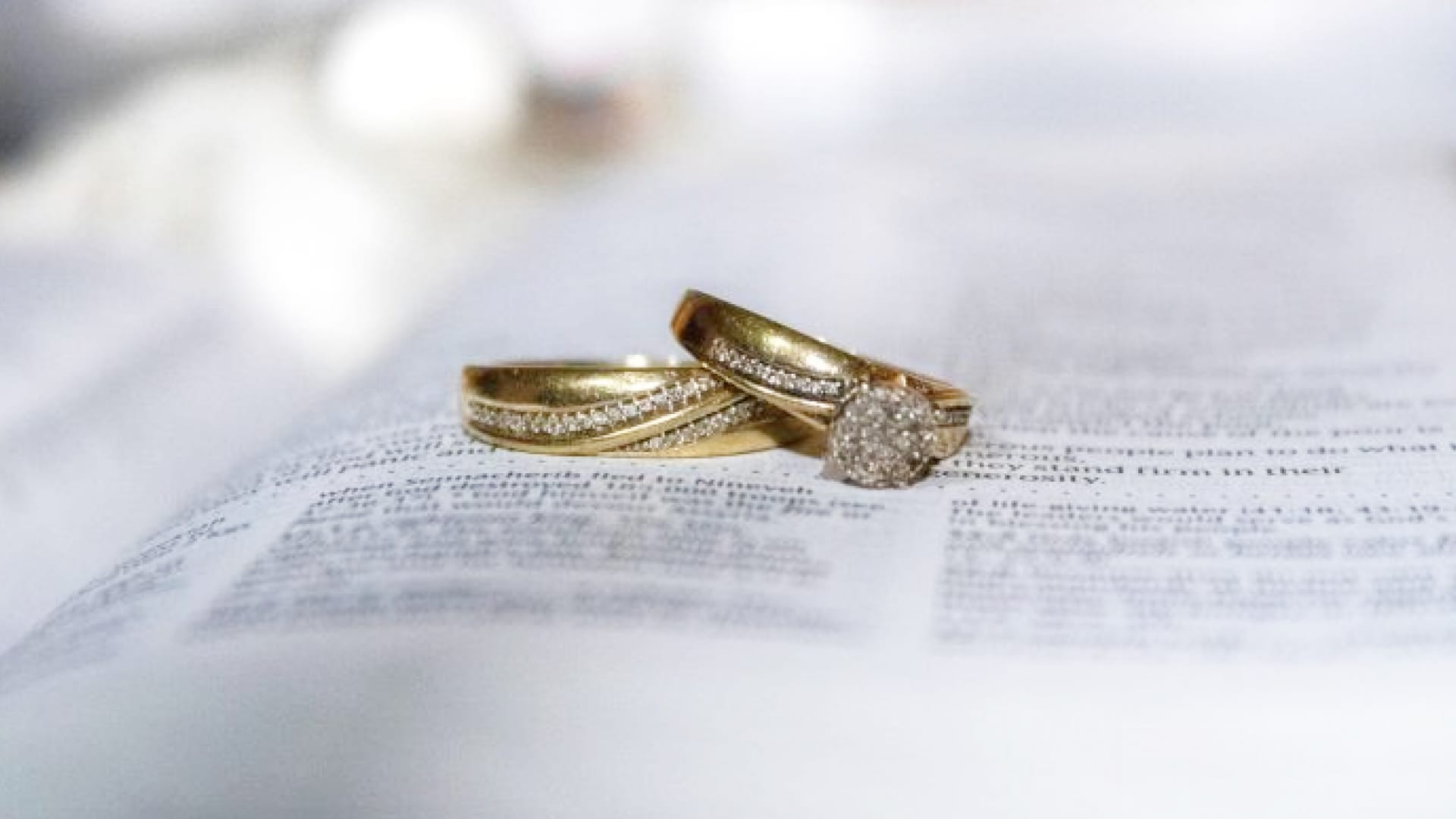
It has become traditional across many cultures to exchange wedding rings as a tangible token of covenant love. Rings are easily and readily characterized only as a symbol of “eternal love” since they are in the shape of a circle. While this aspect of the significance of the ring is important, there is much more to consider. The rich symbolism of wedding bands is deeper and fuller than this one aspect.
The history of wedding rings stretches back many centuries to the ancient world. In Egypt, husbands and wives exchanged simple bands of woven reeds as a token of love. In ancient Rome, metallic bands, often richly engraved, were placed over the vena amoris, the vein in the left fourth finger that was believed to lead directly to the heart, on the left side of the chest. Thus, the custom became to wear the wedding ring on that particular finger.
In spite of undeniable roots in the pagan world, we find abundant references to rings and bridal jewelry throughout the Bible and in early Christian history. In Genesis 24:29–30 and 46–47, Abraham’s servant gave ornate jewelry to Rebekah, the bride the Lord had chosen for Isaac. In the writings of the prophet Isaiah, reference is made to a bridegroom that “decketh himself with ornaments” and a bride that “adorneth herself with her jewels” (Isaiah 61:10).
Early Christians living in the Byzantine Empire exchanged wedding rings engraved with religious symbols and texts. Occasionally, one of these ornate wedding rings from the early days of Christianity is uncovered in an archaeological dig. The discovered ring, a poignant token of a married Christian couple, is assumed to indicate that the couple lived and died in the bonds of covenant union centuries ago.
Some Christians eschew all jewelry, seeking simplicity in their life and possessions. This choice is a matter where there is room for Christian liberty and a need for charity on both sides. For those who do choose to exchange rings, the following are some important benefits to consider.
Rings symbolize value
Rings are usually crafted of gold, silver, or titanium. Sometimes they are engraved with names, Scripture verses, or set with jewels. In a traditional marriage ceremony, these words are often used in whole or in part from the Anglican Book of Common Prayer: “This gold and silver I give thee,” and are followed by the words “with this ring I thee wed.” The ring accompanied the dowry and was a token of financial responsibility and the promise of the bridegroom to care and provide for his bride.
Rings symbolize willing bondage
It is not by accident that wedding rings are often called wedding bands. In ancient days, rings were sometimes worn by slaves, indicating that the wearer belonged to someone else. In a very real way, a wedding ring is a visual sign that we are no longer our own. A man who wears a wedding band is testifying to every other woman in the world that he belongs to his wife, and his wife alone. A woman wearing a wedding band is publicly proclaiming that she belongs to her husband, and her husband alone. Marital unfaithfulness is the breaking of a bond of fidelity.
Rings symbolize eternity
A ring is an unbroken circle and testifies that the marriage covenant endures until death. In ancient days, some rings were intricately constructed bands that, once they were removed, would come apart in such a way that they could not be put back together.
May God help all of us who wear a wedding ring to appreciate all the rich symbolism that is expressed by this simple band of union.

 24:18
24:18