

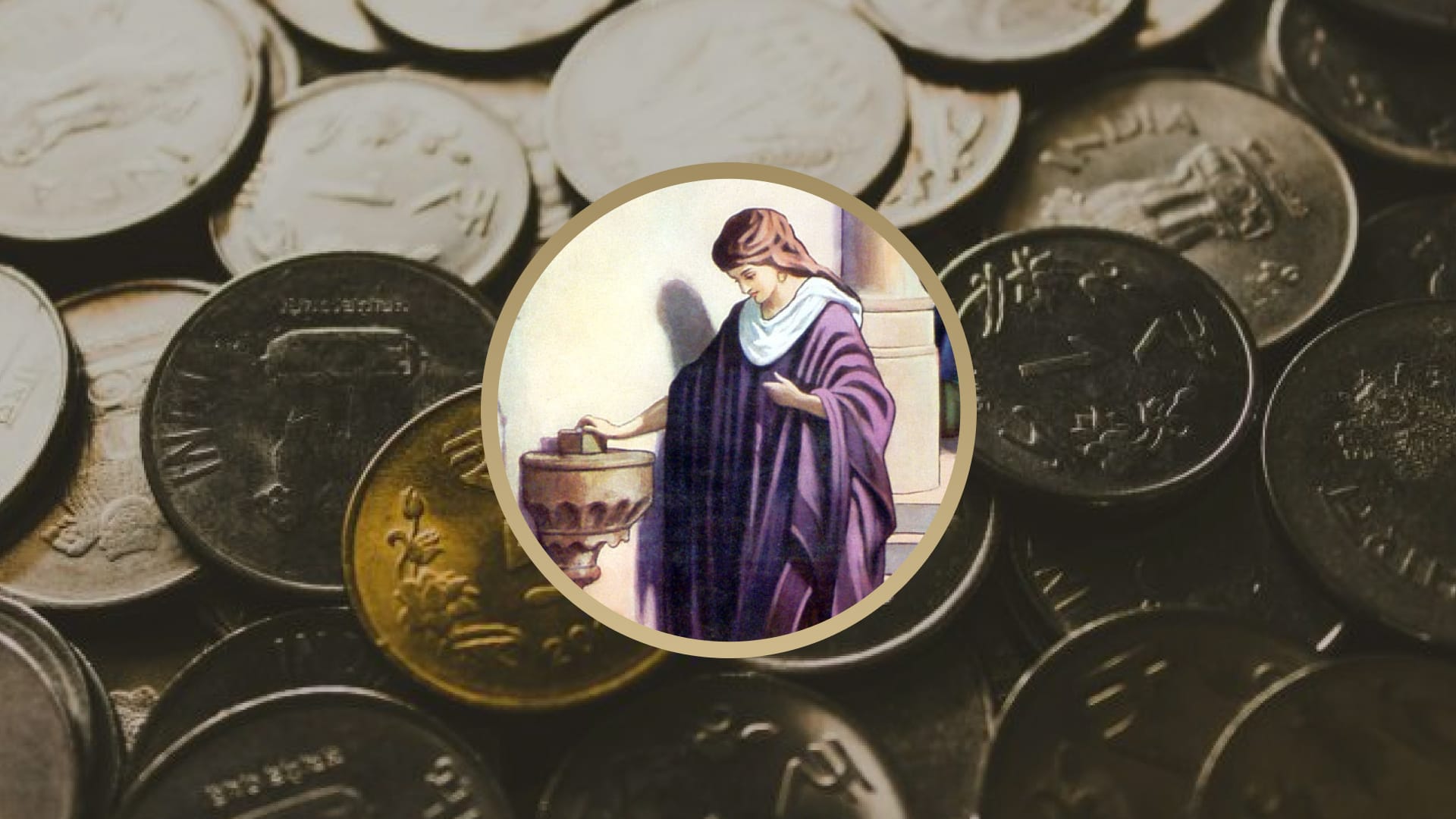
In the Sermon on the Mount, Jesus told His disciples, “But lay up for yourselves treasures in heaven, where neither moth nor rust doth corrupt, and where thieves do not break through nor steal: For where your treasure is, there will your heart be also” (Matthew 6:20–21).
One disciple of Christ who followed this command most fully is an unnamed widow. Christ encountered this woman in the Temple during the final week of His earthly ministry. The brief account of her deed of generosity is recorded in the Gospels of Mark and Luke.
The context of our Lord’s comment upon the widow’s offering is important. She gave her offering on Tuesday afternoon of Christ’s Passion Week. The day before—Monday—Christ had entered the Temple and purged it of the money changers and those who sold sheep and doves in the Temple court.
On Tuesday, the discussions in the Temple’s outer court had already been long and heated. Christ had just finished His lengthy, direct condemnation of the scribes and Pharisees: He had openly accused them of rampant hypocrisy and of following man-made innovations in the worship of God.
Matthew recorded the full speech in chapter 23 of his Gospel. In Luke’s Gospel, he gave only a brief report in two verses, immediately prior to mentioning this poor widow. “Beware of the scribes, which desire to walk in long robes, and love greetings in the markets, and the highest seats in the synagogues, and the chief rooms at feasts; Which devour widows; houses, and for a shew make long prayers: the same shall receive greater damnation” (Luke 20:46–47).
Although there is a chapter break at this point, there was no interruption in the action. Following Christ’s comment recorded in the preceding chapter, the opening verse of chapter 21 notes, “And he looked up, and saw the rich men casting their gifts into the treasury.”
What was the purpose of a “treasury box” in the Temple? In the days of King Joash, under the supervision of the Godly priest Jehoiada, “Jehoiada the priest took a chest, and bored a hole in the lid of it, and set it beside the altar, on the right side as one cometh into the house of the LORD: and the priests that kept the door put therein all the money that was brought into the house of the LORD” (II Kings 12:9).
The large chest had been set up in Solomon’s Temple to accommodate the gifts of those who brought a freewill offering toward the repair of the Temple. Solomon’s Temple was later destroyed by the Babylonians. When Herod’s Temple was completed, a box of the treasury was, according to custom, set inside as well. The collection of money was intended for Temple upkeep, support of the priests and Levites, and distribution for charity among the poor.
Earlier in His ministry, in the Sermon on the Mount, Christ had given a strong rebuke to those who gave charity for the selfish motive of obtaining the praise of men. “Take heed that ye do not your alms before men, to be seen of them: otherwise ye have no reward of your Father which is in heaven. Therefore when thou doest thine alms, do not sound a trumpet before thee, as the hypocrites do in the synagogues and in the streets, that they may have glory of men. Verily I say unto you, They have their reward. But when thou doest alms, let not thy left hand know what thy right hand doeth: That thine alms may be in secret: and thy Father which seeth in secret himself shall reward thee openly” (Matthew 6:1–4).
In Luke 21:1, such was the case with the rich men casting their gifts into the treasury. These rich men that Jesus observed would come with great pomp and outward show, and they would ostentatiously deposit an entire bag of silver coins into the treasury.
However, Jesus instead called the attention of all the bystanders to another figure giving her gift in the Temple. Behind the procession of rich merchants in their elaborate garments and with their obviously filled money bags was a meek, almost unnoticed donor. “And he saw also a certain poor widow casting in thither two mites” (Luke 21:2).
Consider this particular worshipper. She had not come that day to make a spectacle. In all likelihood, she was probably humbled by the meagerness of her offering. All she had to give were the two smallest coins, two mites. In the currency of Bible times, two mites were equal to a farthing. What could a farthing buy? Jesus had once noted “Are not two sparrows sold for a farthing?” (Matthew 10:29). Although all the widow gave was two mites, she did so with a generous heart. She gave all of what she had.
One reason this treasury existed was for the support of widows such as her. She could very well have reasoned, “I do not need to give money into the treasury. This box was put here to support people like me.”
But apparently this woman did not entertain such a practical rationalization. Instead, she seemed to have recognized that all she had was from God. He had blessed her with two mites. She would return to Him those two mites because she loved the Lord more than she loved herself. Similar to the widow of Zarephath in the Old Testament who gave up her last little cake to Elijah, the man of God, this New Testament widow willingly gave the last two coins she possessed.
At the very moment that she quietly slipped up to the box and deposited her two coins, Jesus of Nazareth saw her.
Jesus then called the attention of His disciples to this widow. “And he said, Of a truth I say unto you, that this poor widow hath cast in more than they all: For all these have of their abundance cast in unto the offerings of God: but she of her penury hath cast in all the living that she had” (Luke 21:3–4).
After this brief account, we learn nothing more about this widow. Christ proceeded to accomplish the work His Father had given Him. In three more days from this moment in the Temple, He would be nailed to a Roman cross.
In the Book of Acts, another character was recorded as possessing the same generosity and love for God as the poor widow who gave all she had. Barnabas had more, much more to give than two tiny mites. He was a rich landowner! Yet, he willingly sold his land and gave the price thereof to the support of the cause of Jesus Christ. It is a worthwhile consideration that perhaps the offering Barnabas gave may very well have gone to the support of this poor widow in Jerusalem whom Jesus commended! Perhaps she even was among the widows mentioned in Acts 6, who received the assistance of the newly appointed deacons.
Whatever is given to Christ is never a loss. You can never lose by choosing to give all you have to Christ and the work of His Kingdom. The favor of the Master is worth more than all the silver and gold in the world. This unnamed widow provides us a splendid example of true discipleship. According to Luke 14:33, Jesus taught, “So likewise, whosoever he be of you that forsaketh not all that he hath, he cannot be my disciple.”
What are you tightly holding onto? Do you perhaps obviously, outwardly make a show of your giving rich gifts to the Master, but inwardly you know your gift is given from a selfish motive and a desire for men’s applause? Are you secretly clinging to the things you really hold dear? Christ desires your open hands with the little you have to give, like the two mites of the widow, more than the offering of all the finest gold of Ophir.
No matter your financial state or status, Christ calls upon each of us not to give Him our leftovers or the things that have cost us nothing but to give Him everything that we possess and are. This is the cost of true discipleship. Christ desires us to lay before Him our very lives that we might truly be His disciples.

 23:50
23:50