

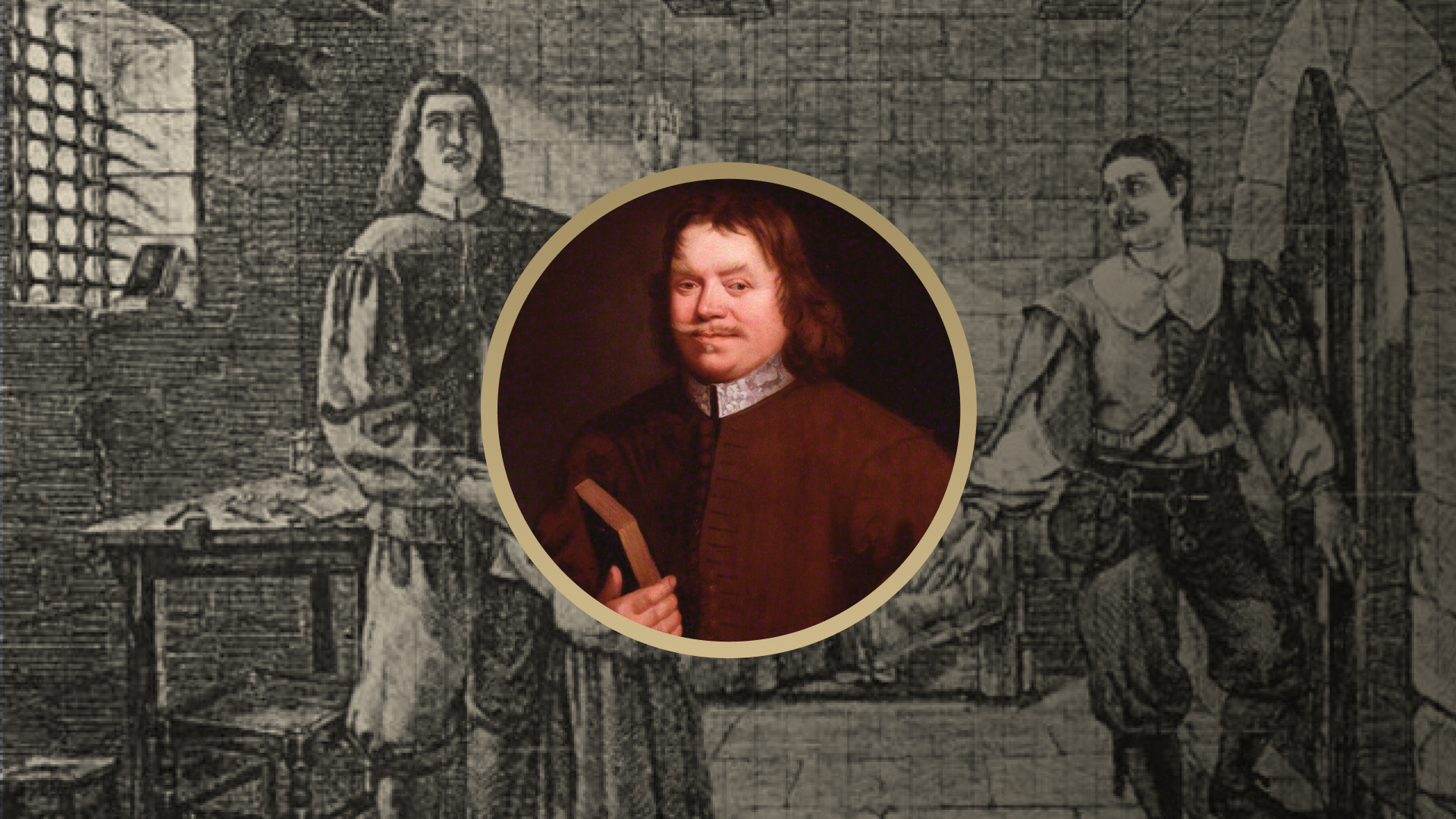
Near the village of Bedford, England, a small group of men, women, and children had assembled to worship the Lord in spirit and in truth. It was not a cathedral that they were in, and everyone in the room knew that this Nonconformist meeting was illegal. The sound of larks and sparrows took the place of the peals of the organ. There was no high altar, no surplice (vestments), no prayer book, no candles, and no stained glass. A simple table served as a pulpit, and upon it rested the well-worn Bible of John Bunyan, their pastor.
Most of these people were farmers. Just as it was said of our Lord Jesus, “The common people heard him gladly,” so the same could be said of John Bunyan. He was a tinker by trade, a mender of pots and pans, and he spent the week traveling through the countryside with his portable brazier. In the countryside while talking to farmers and their wives, John Bunyan had come to know the common people and their language. He spoke to them in a direct way that they understood and loved.
But of all the faces there in the cottage that day, a few were dearest to him. Nearest the pulpit was seated his wife, Elizabeth, and their children. Because of John Bunyan’s many years in prison, Elizabeth Bunyan had been forced by circumstances to raise the children almost alone. By 1675, her husband had already spent twelve years of his life in Bedford’s local jail.
At Elizabeth’s side sat the children God had given them. Mary, the oldest daughter, had been blind from birth and had never seen the light of the sun. Bunyan’s few references to her were always tender, and he tenderly called her “my poor blind child.” Sometimes, during her father’s extended imprisonments, Mary had been forced to beg for the sustenance of the family. Her father’s heart ached regarding this, but as he told his family, “I must venture all with God, though it goeth to the quick to leave you.”
On this day, the eyes of “poor blind Mary” were raised to meet her father’s eyes. While her physical eyes could see nothing, her spiritual vision was very clear! Little did John Bunyan know that this day would bring him yet another painful separation.
As the singing ended, the snort of a horse was heard outside. A party of armed men stomped up the stairs and into the room. Elizabeth Bunyan knew full well what the sound meant, and God’s past mercy gave her renewed strength for the hour. The assembled saints kept their seats, and all eyes were fixed, not upon the sheriff and his men, but upon their beloved pastor. John Bunyan looked the sheriff calmly in the eye and announced his text from Luke 23:40, “Dost not thou fear God?”
Instead of breaking up the service, the sheriff quietly took a chair. His men did likewise. Bunyan could sense the abiding power of God in the room, and he knew that he must obey God rather than men. Slowly, Bunyan read again his text from the words of the penitent thief on the cross, “Dost not thou fear God?” He continued to read the felon’s testimony recorded in Luke 23:40-41, “seeing thou art in the same condemnation? And we indeed justly; for we receive the due reward of our deeds: but this man hath done nothing amiss.”
When Bunyan looked up from his Bible, he saw the sheriff visibly shaken by the text. The sheriff was holding the warrant for Bunyan’s arrest, but the hand that held the warrant began to tremble. Bunyan knew the power of the Word of God, and he proceeded, “Behold how this man trembles at the Word of God.”
Then, John Bunyan proceeded to preach. He described the wretchedness of man’s sin and the perfect righteousness of the Lord Jesus Christ. Bunyan knew what it was to be a lost, dying sinner. He himself had once been a man as wicked as the sheriff, a blasphemous, lustful, and proud young man. The text brought to mind Bunyan’s own conversion. He recalled the passages of Scripture that seemed to forever condemn him under the righteous judgment of an offended God.
He had been terrified by the Scriptures in Hebrews 10:31 that warned of falling “into the hands of the living God.” He feared that he, like Esau, could find no place of repentance. But eventually, Bunyan found rest in the Lord Jesus, and the burden of sin rolled from his shoulders at the foot of the cross.
In his autobiography, Grace Abounding to the Chief of Sinners, John Bunyan related the agonizing process by which God brought him from sin to salvation, from doubt to faith, from darkness to light, and from defeat to victory. Now, in his sermon on this particular day, he sought to proclaim the Good News of salvation to farmers and the sheriff alike. If the grace of God could save “the chief of sinners”—John Bunyan himself—the same grace could save the sheriff.
Through the entire sermon, the sheriff sat riveted to his seat. At the end of the preaching, the sheriff could not bring himself to bind the man of God! Instead, with great respect, he served the arrest warrant to John Bunyan and told the Nonconformist preacher that he should follow him to the Bedford jail.
Then, the sheriff left the cottage. Bunyan was a free man at that moment. He could have disappeared into the hills. He could have disguised himself. There may have been times when this would have been appropriate. But John Bunyan believed that he should demonstrate before his family and congregation that he was willing to suffer for the sake of the Lord Jesus. He was not afraid of imprisonment or even of death.
The most difficult part of the arrest was to be separated again from his wife and children. However, Bunyan had taught them that the Christian life demands sacrifice for the cause of truth. He wrote in his autobiography: “I had also this consideration, that if I should now venture all for God, I engaged God to take care of my concernments; but if I forsook him and his ways, for fear of any trouble that should come to me and mine, then I should not only falsify my profession, but should also count that my concernments were not so sure, if left at God’s feet, while I stood to and for his name, as they would be, if they were under my own care.”
Having chosen the narrow path of difficulty, John Bunyan entrusted his family into the care of God and then walked freely into the Bedford jail. In some ways, these months of his final imprisonment were the most important months of his life. During these six months of imprisonment, he wrote his most famous and lasting work, The Pilgrim’s Progress.
Since he was a tinker by profession, the clergy of England considered John Bunyan to be ignorant and illiterate. But from his prison cell, Bunyan wrote a book that has been the world’s best-selling book ever written originally in the English language. The book’s popularity cannot be explained apart from the fact that men and women see in its author an honest portrayal of the spiritual realities of life. Under the blessing of the Holy Spirit, the writings of John Bunyan have made invisible spiritual realities very visible and understandable.
In many ways, John Bunyan’s famous allegory is an extension of his own autobiography. He reminds every pilgrim that the Christian life is never easy. Even after Pilgrim’s sins rolled away at the foot of the cross, there were struggles and hardships in his life. Doubting Castle looms big, and Giant Despair is very real. Doubts, fears, struggles, darkness, and sorrow are just as much a part of the Christian’s life as victory is. Apollyon must be met and conquered. But beyond the River of Death there awaits the glorious realities of the Celestial City!
John Bunyan reached the end of his own pilgrimage in 1688. His faith was put to the final test as he came to the brink of the River of Death. “Jesus, the mediator of the new covenant” (Hebrews 12:24) had sustained him in life and was there again to sustain him in death.
Bunyan had recorded in The Pilgrim’s Progress that when Christian and his companion emerged from the river, they were met by two shining ones with this triumphant message, “Ye are come unto mount Sion, and unto the city of the living God” (Hebrews 12:22). The life of John Bunyan encourages every sincere pilgrim who has come through the gate of Jesus Christ and walks faithfully in the narrow way that leads to the Celestial City.
Sources and Further Reference:
Bunyan, John. Grace Abounding to the Chief of Sinners. London, UK: Penguin, 1987.
Duke, Roger D., and Phil A. Newton. Venture All for God: Piety in the Writings of John Bunyan. Grand Rapids, MI: Reformation Heritage Books, 2015.




 21:37
21:37