

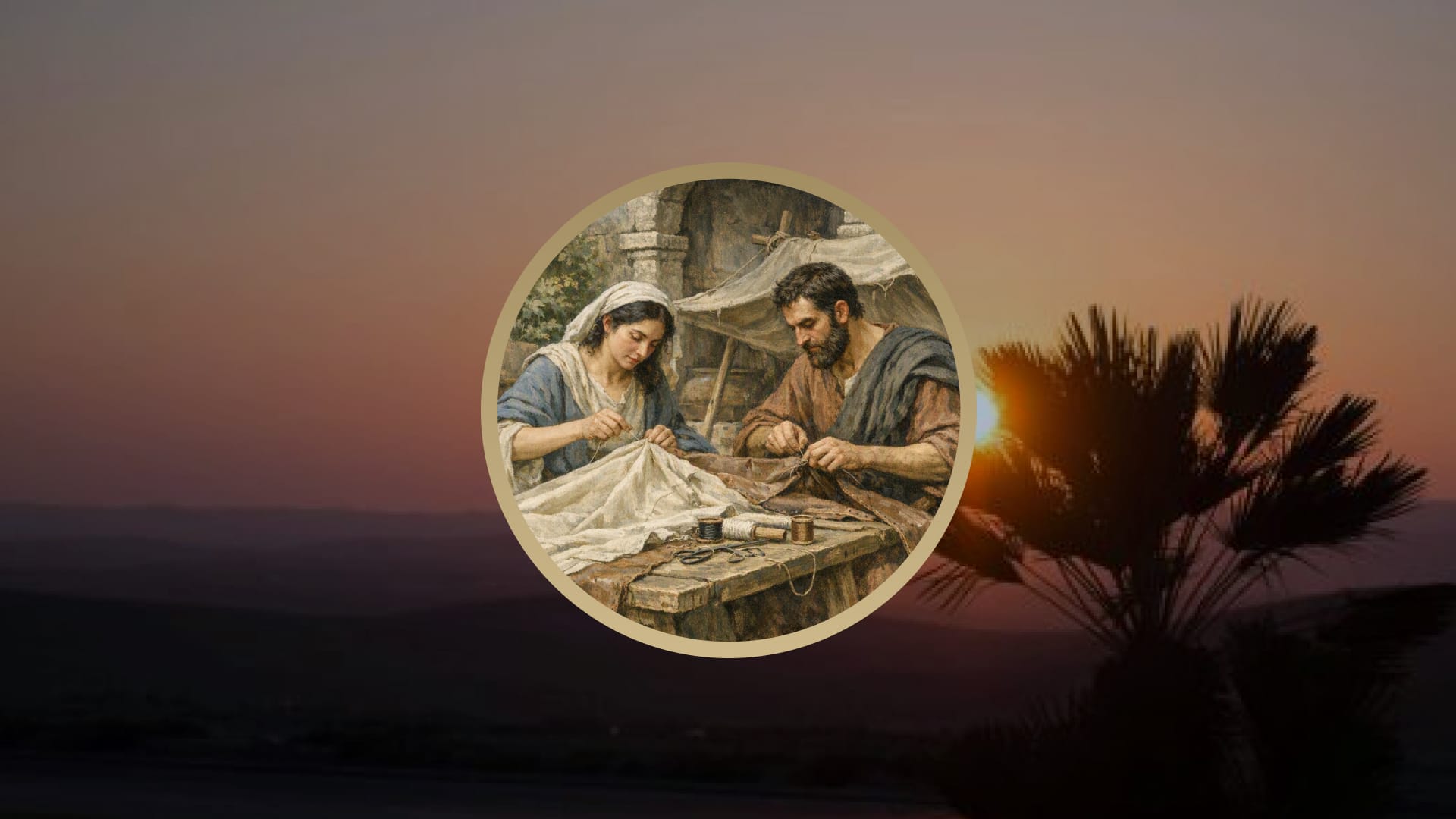
Aquila and Priscilla were ordinary people, humble tentmakers who lived out genuine, practical Christianity in day-to-day life. The couple is the supreme example of a Christian husband and wife working together for the advancement of the Gospel.
As far as the Scripture records, this couple never wrote a book. They never stood before the Sanhedrin or a king. The indication in Scripture is that this couple wasn’t in the limelight. But in many quiet and sincere ways, they served the Lord Jesus Christ and the Christians around them. They made their dwelling a house of prayer, and many were edified there.
These two Christians appear in the New Testament. They pop up in unexpected places: Rome, Corinth, Ephesus, Rome, and then Ephesus again. In the various locations, they were making tents with Paul, inviting a zealous preacher into their home for personal gentle instruction, and hosting assemblies of believers for prayer, teaching, and fellowship. They are often mentioned first in Paul’s lists of greetings, and he called them my “helpers in Christ Jesus” (Romans 16:3).
Paul recorded that on one occasion this couple laid down their own necks for his life! Their hardships likely included early mornings, late nights, sore fingers, aching backs, constant intrusions on their time, and daily sacrificial living. Yet, the couple endured their hardships patiently and cheerfully for Christ’s sake. The first mention of Aquila and Priscilla is when their path crossed with the Apostle Paul’s, in Acts chapter 18.
That first meeting occurred around A.D. 51, while Paul was on his second missionary journey. He had just recently preached his famous sermon on Mars Hill in Athens, Greece. “After these things Paul departed from Athens, and came to Corinth; And found a certain Jew named Aquila, born in Pontus, lately come from Italy, with his wife Priscilla; (because that Claudius had commanded all Jews to depart from Rome:) and came unto them. And because he was of the same craft, he abode with them, and wrought: for by their occupation they were tentmakers” (Acts 18:1–3).
God used the decree of a pagan emperor to move Aquila and Priscilla from Rome to Corinth. Their friendship with Paul, once formed, lasted for a lifetime.
When Paul arrived in Corinth, he did not arrive as a modern missionary does—with support, a travel allowance, scheduled furloughs, or a planned retirement program. No, the apostle was alone in a pagan city. He had no funds provided or promised. In those days, even rabbis learned a trade by which they could support themselves and their families in times of hardship. The Judeo-Christian ethical system of Biblical principles dignified the lot of the working man.
Thus, for that reason, we find Christians in the New Testament who were fishermen, soldiers, farmers, merchants, jailers, landlords, and bondslaves. Even Jesus Himself earned bread by the sweat of His brow for most of the first thirty years of His earthly life, laboring on the bench of the carpenter’s shop. And the Apostle Paul, like his Lord, was a working man. He was a tentmaker.
Tentmaking was not a pleasant job. It was difficult, painstaking work. The main type of tent in Biblical times was made of woven goat’s hair. The rough black cloth was very tough and heavy, yet because of its composition, it would readily resist water in the rainy season and keep out the sun during the dry season. This material was heavy and very challenging to work with.
Aquila and Priscilla were already set up in this trade when Paul arrived in Corinth. It is not known from the Scripture account whether or not Aquila and Priscilla were already followers of Christ when Paul arrived in Corinth. The text says nothing about their conversion. Since there were Roman Jews in Jerusalem on the Day of Pentecost, the couple may have heard the Gospel message in Rome from the Jews present at Pentecost. Or, possibly they could have heard it from Paul’s lips in Corinth as they worked together making tents.
Either way, when Aquila and Priscilla appear again in the record of Acts, they were already solid Christians. According to Acts 18:5, Silas arrived from Macedonia with a monetary gift for the apostle’s ministry, and as a result, Paul was able to leave the workman’s bench and devote all day to the Gospel ministry.
Paul’s friendship with Aquila and Priscilla continued. After eighteen months of delightful fellowship in Corinth, the Scripture states, “And Paul after this tarried there yet a good while, and then took his leave of the brethren, and sailed thence into Syria, and with him Priscilla and Aquila” (Acts 18:18).
At this point, Paul had only known this husband and wife for about a year and a half. Already, they were so spiritually profitable to the apostle and so vital to God’s work that they accompanied him across the Aegean Sea to Ephesus.
Once in Ephesus, Aquila and Priscilla remained to lay the groundwork for Paul’s future ministry there during his third missionary journey. Remember: after Paul’s second missionary journey, there was no regular assembly of believers in Ephesus. One day a faithful church would be there, but it was not yet established when Aquila and Priscilla took up residence there. The couple was alone in a large city and worshipped with their fellow Jews in the synagogue.
During Paul’s absence, a visitor arrived in Ephesus. “And a certain Jew named Apollos, born at Alexandria, an eloquent man, and mighty in the scriptures, came to Ephesus. This man was instructed in the way of the Lord; and being fervent in the spirit, he spake and taught diligently the things of the Lord, knowing only the baptism of John. And he began to speak boldly in the synagogue: whom when Aquila and Priscilla had heard, they took him unto them, and expounded unto him the way of God more perfectly” (Acts 18:24–26).
What humility and grace we find in this account, not only in Priscilla and Aquila, but also in Apollos! This private instruction by the believing couple to the uninformed eloquent speaker crossed all social barriers and defied all accepted cultural norms. Aquila and Priscilla must have exhibited unusual grace and humility to teach such a learned rabbi. Instead of openly challenging the visiting preacher, they kindly invited him into their home to speak with him.
On the other hand, Apollos also showed unusual humility! He accepted their invitation, and in their home, he listened to the Good News graciously presented by the lowly tentmaker and his wife. As a result, he left their home a sharper and wiser man.
At this point, ponder: Is your marriage, home, family, and your knowledge of Scripture such that guests depart from your home better informed about Christ than when they entered?
Apollos proceeded to become one of the great preachers of the early church, having been instructed by a tentmaker and his wife. Eventually, Paul returned from Jerusalem to Ephesus. He spent another two years, almost three, there with Priscilla and Aquila. It seems that Paul lived with them again during this time. And thus, Aquila and Priscilla enjoyed two more years of close fellowship with the Apostle Paul. Together they suffered persecution. Together they saw the mighty working of God. “So mightily grew the word of God and prevailed” (Acts 19:20).
During this time of approximately two years and several months, Paul wrote his first epistle to the church at Corinth. In that letter, he mentioned his two faithful companions: “The churches of Asia salute you. Aquila and Priscilla salute you much in the Lord, with the church that is in their house” (I Corinthians 16:19).
No further mention of Aquila and Priscilla is recorded in the Book of Acts. The Apostle Paul moved on from Ephesus; he crossed into Macedonia and Greece, continuing his third missionary journey. But he didn’t mention the couple again in the Biblical record in Acts.
So, did Priscilla and Aquila settle in Ephesus for the rest of their lives? No. The Apostle Paul had long seen the value of evangelizing the city of Rome. It was the capital of the civilized world, the centerpiece of government, and the headquarters of the mighty Roman Empire. The place was also a metropolitan city with many cultures mixing together on the streets. Just as Aquila and Priscilla had labored in Ephesus to prepare the way for Paul, so now they had relocated to Rome and there did the same.
Paul wrote to the believers dwelling in Rome to “Greet Priscilla and Aquila my helpers in Christ Jesus” (Romans 16:3). Rome was the couple’s native city, the city from which they had been driven about seven years earlier by a Roman imperial decree.
The apostle continued his closing remarks, adding this intriguing comment about Aquila and Priscilla, “Who have for my life laid down their own necks” (Romans 16:4). At some time during those two years in Ephesus, this Christian couple actually laid down their own necks for the sake of Paul’s life! Nothing more does Paul write about them other than this brief reference. We will have to wait until Heaven to ask this couple about this time when they offered their lives for the Apostle Paul. Paul added in the same sentence, “unto whom not only I give thanks, but also all the churches of the Gentiles.”
If this were the last that is recorded about Aquila and Priscilla, it would serve as a fitting epitaph. However, the record of their faithful life of service was not yet complete. In Paul’s final letter to Timothy, he mentioned his dear friends again. He wrote to Timothy, “Salute Prisca and Aquila” (II Timothy 4:19).
Apparently, after another ten years away, Aquila and Priscilla had returned to Ephesus. They were back in the place where they had once spent two sweet years with Paul in the church they helped found. This was the place where they previously had their tentmaking shop, where they had taught Apollos the way of the Lord more perfectly, and in the same place where they had once laid down their own necks for Paul’s life. Always, their house was a house of prayer, and Paul remembered this precious couple during his final days on earth.
 22:09
22:09