

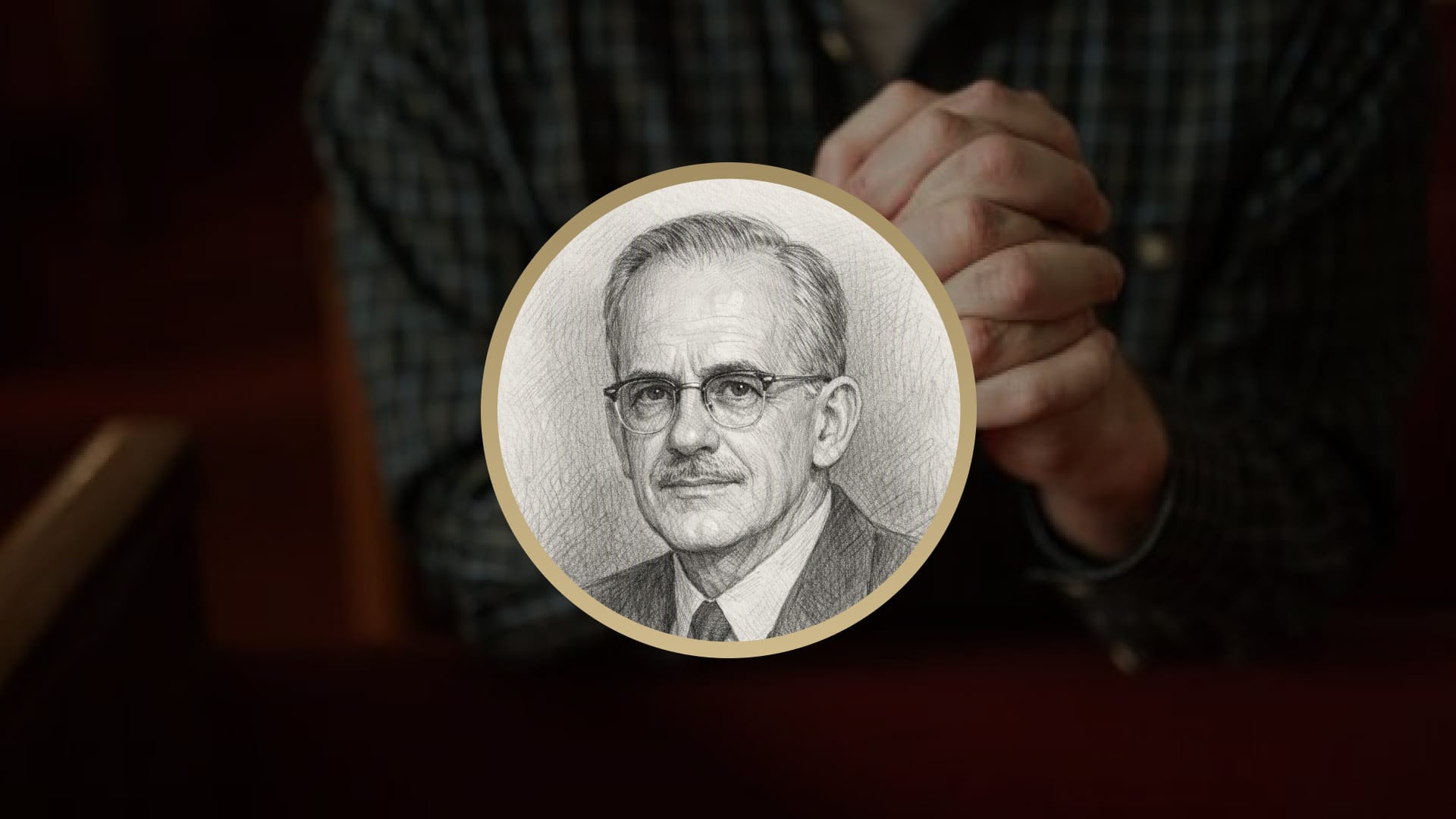
Many people know the name A. W. Tozer. However, fewer know the life of the man behind the writing. Aiden Wilson Tozer was born in rural Pennsylvania on April 21, 1897. He was born into a family of farmers. His parents were very poor. Tozer was one of six children.
Tozer’s early education was extremely limited. He attended a country one-room schoolhouse and learned to read from the McGuffey book series. Beyond this, Tozer was a self-taught boy. When his father moved the family to Akron, Ohio, and found steady work in a rubber mill, young Aiden delighted in access to a public library!
As the boy became a man, Tozer also worked in the rubber industry, making rubber tires for the booming automobile industry. His free moments were spent reading borrowed library books, which became the major factor in his education. In many ways, Tozer was truly self-taught.
The Tozer family was not very religious. The Bible was a closed book in their home and they did not regularly attend church. A kind neighbor named Mr. Holman took a spiritual interest in sixteen-year-old Aiden and pressed him about the needs of his soul. This neighbor began praying that young Tozer would be converted to Christ. One day, while Tozer was walking home from the rubber factory, he heard a street preacher proclaiming the text, “Lord, be merciful to me, a sinner.”
This simple prayer gripped the young man’s heart. He knew that he was a sinner. Like the poor publican who cried out for forgiveness in the parable, A. W. Tozer cried out that very day for mercy. He was a changed man. Old things passed away, and all things were new!
Tozer soon found a quiet place in the basement of the family home where he could commune with God. He would retire there behind the furnace to study his Bible and pray. He also began meeting with other believers whenever he had the opportunity.
Initially, Tozer was united with the Methodist Church. But he soon joined the Christian and Missionary Alliance congregation. Friends saw Tozer’s zeal for the Lord and his love for God’s truth. In spite of the lack of any formal theological training, A. W. Tozer was soon receiving invitations to preach and exhort believers.
Acknowledging his own weakness apart from the power of Christ, Tozer prayed, “Give me a vision to see and courage to report what I see faithfully. Make my voice so like thine own that even the sick sheep will recognize and follow thee.”
Tozer met a young lady named Ada Cecelia Pfautz. Her mother had come to appreciate Tozer’s preaching and teaching. Mrs. Pfautz worked hard to find locations for Tozer to preach while also encouraging the romance between her daughter and the young preacher! Ada Pfautz and A. W. Tozer were married in 1918. At the time, Tozer was serving the Lord as an itinerant evangelist. He continued to do so for several years after his marriage.
In 1928, a call came from the Southside Christian and Missionary Alliance church in Chicago, Illinois. Tozer accepted the call. He served this congregation for thirty-one years. During these years of ministry, Tozer continued to read, study, and pray. He also began to express his heart in writing.
Tozer’s habit was to arrive at his pastor’s study very early in the morning. He would change out of his dress slacks into a pair of old pants that could get wrinkled. Then the pastor would begin to pray on the couch. However, very soon he would move to the floor and there pray on his face before the Lord.
A. W. Tozer was grieved by the formalism and coldness of mainstream Christianity. He yearned for true and lasting revival among God’s people. From his study, from his pulpit, and by means of his powerful pen, he called upon the children of God to shun materialism. He warned that the Gospel had been adulterated by false shepherds who were entertainers rather than preachers and who governed their churches like business executives rather than as men of God. He rightly proclaimed that preaching should convict men of sin, righteousness, and judgment.
Prayer was essential to Tozer’s ministry. He remarked, “No man should stand before an audience who has not first stood before God. Many hours of communion should precede one hour in the pulpit. The prayer chamber should be more familiar than the public platform. Prayer should be continuous, preaching but intermittent.”
Reading fueled Tozer’s writing. No man that writes can afford not to read widely and deeply. Tozer read a wide variety of books, even from sources not often consulted by mainstream Protestant denominations. He read the plays of Shakespeare. He read Thomas à Kempis. He read Bernard of Clairvaux. He read Augustine of Hippo. He even read the Quakers. He did not agree with all that he read, but he gleaned truths wherever he found them.
One of Tozer’s best known works, The Pursuit of God, was written over the course of one all-night train ride! He boarded a Pullman train in Chicago to travel to a speaking engagement in McAllen, Texas. Once aboard and settled, he asked for a writing table and started writing. With only tea and toast for his sustenance, Tozer wrote and wrote as the train made its way southward through the darkness. The words flowed from his heart to his pen as fast as he could write them. By dawn, the book was done! He wrote, “Self is the opaque veil that hides the Face of God from us.”
After a long ministry in Chicago, Tozer was invited in 1959 to come to Canada and serve at Avenue Road Church in Toronto. There he continued to preach, write, and pray.
Sadly, Tozer’s own family suffered from his busy life of travel and isolation. He spent so much time in his private devotions that his own children were neglected. While emphasizing the spiritual, he sometimes neglected the very real physical and emotional needs of his wife and children. Despite this weakness, his wife was devoted to him over the course of forty-five years of marriage that lasted until Tozer’s death. Ada Tozer had a gift for hospitality, and she was able to fill a role of service to needy souls in the community that her husband was not.
Over time, Tozer began to realize that Christians were not living holy lives because they did not understand or appreciate the holiness of God. This realization was the motivation for one of Tozer’s best known books, The Knowledge of the Holy.
A. W. Tozer died May 1963, after a brief struggle with heart trouble. He was only sixty-six years old, but his ministry had been fruitful. His books, filled with Biblical truth, continue to be read and studied by Christians today from many denominations all over the world. His simple grave in Akron, Ohio, is marked by this epitaph: “A. W. Tozer – a Man of God.”
Sources and Further Reference:
Dorsett, Lyle W. A Passion for God: The Spiritual Journey of A. W. Tozer. Chicago: Moody Publishers, 2008.
Fant, David J. Jr. A. W. Tozer: A Twentieth-Century Prophet. Chicago: Moody Press, 1964.


 22:09
22:09