

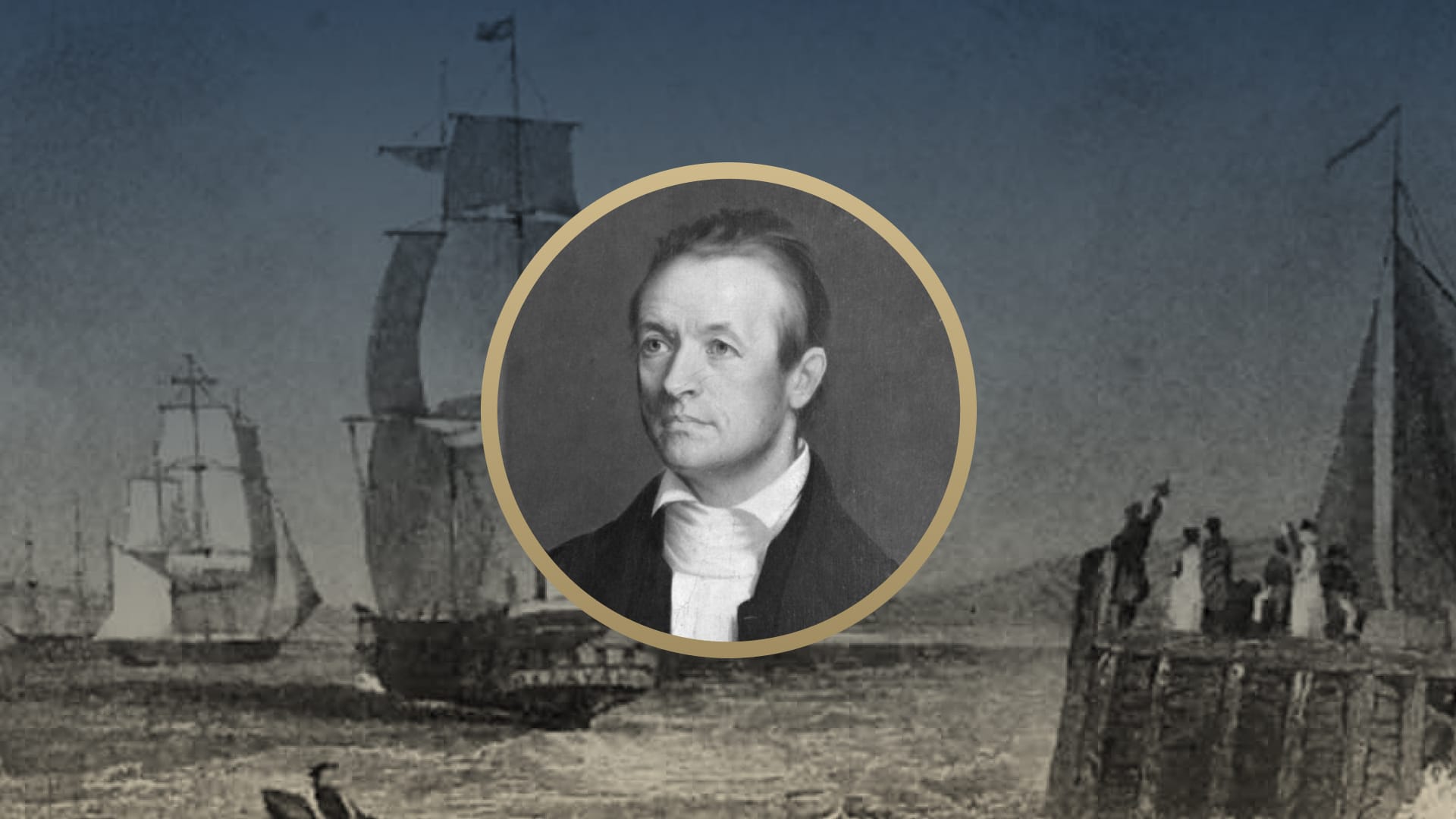
February 1812 was a month filled with dramatic changes for a young American missionary named Adoniram Judson. On the fifth of the month, he was married to Ann Hasseltine. The day after his marriage, the groom was ordained as a minister of the Gospel in the Congregational Church in Salem, Massachusetts. Two weeks later, on February 19, Adoniram and Ann, called “Nancy” by her new husband, boarded a ship bound for a land unknown to them on the other side of the world.
Adoniram Judson was born on August 9, 1788. His father was a Congregational pastor who served for a time at the historic Pilgrim church in Plymouth, Massachusetts.
During his days as a college student, Judson’s faith was shaken by a close friendship with a worldly, reprobate deist named Jacob Eames. Eames openly mocked orthodox Christianity. Under the spell of this dangerous friendship, Adoniram Judson abandoned the faith of his fathers and embraced the enlightenment thinking of the French rationalists.
His skeptical views were shattered by a memorable event when he was traveling one day after graduation from college. While sleeping one night at a roadside inn, young Judson heard wild thrashing and violent cursing from a dying man in the next room.
Judson’s sleep was troubled not just by the noise of this man, but also as he thought about the awful agonies of the dying man, who screamed his way into a vast and unknown eternity. The next morning, Judson inquired of the innkeeper the identity of his dying neighbor and whether or not the man had died. He was informed that the man had indeed died in agony during the night, and that the name of the dead man was Jacob Eames!
The dying agonies of his libertine friend shook Judson’s soul to its very foundations. He returned humbly to the God of his fathers and sought forgiveness for his wanderings. He repented of his sins and trusted the Lord Jesus Christ as God and Savior. With the zeal of his newfound faith, he devoted himself to the Gospel ministry.
Adoniram Judson joined with other likeminded students at Andover Theological Seminary to pray for the cause of global missions. He decided to put action to his prayers and presented himself as a candidate to take the Gospel of Christ to the unreached lands of the Far East. He found a young lady named Ann “Nancy” Hasseltine who was willing to go with him.
On their voyage in 1812 as a newly married groom and bride, more consequential changes were in store for the Judsons. First, war broke out between the United States and Great Britain in what would be known to history as the War of 1812. The war would disrupt communication between the missionaries and their home churches, especially as it related to correspondence and sea travel. The war brought about great difficulty regarding navigation internationally, as the British Royal Navy, who ruled the waves, would not look favorably upon helping a band of American missionaries to India.
The second major change that took place during the voyage was more personal and doctrinal in nature. Judson undertook a careful study of what the Bible had to say about baptism. During the course of his long voyage at sea, he became convinced that infant baptism, practiced by the Congregational Church in which he was ordained, was unscriptural. He became a credo-Baptist by conviction. This change in his convictions meant that upon hearing of his departure from infant baptism, Judson’s sending Congregational churches in Massachusetts would not be willing to support him financially, threatening his entire future.
The Judsons and their associates arrived in Calcutta, India, on June 17, after four months at sea. Judson and his wife, Nancy, were baptized by immersion in India. They wrote a letter to their supporting churches, explaining how their views on baptism had changed. A few Baptist churches would eventually take on the support of the Judsons, but it would be many months before they would learn that money and help were coming their way.
In the midst of all these changes, the American missionaries were ordered by the British East India Company to leave India for good. The British were now waging war on both land and sea against the United States, and the Americans were no longer welcome in India. Driven from the country, the Judsons found a new mission field in the land called Burma.
On the way to Burma, another heart-breaking event occurred. Adoniram and Nancy Judson suffered the miscarriage of their first child. Deprived of financial support, driven out of India, and now bereaved of their expected child, they landed in a strange land whose language and customs were unfamiliar. They began immediately to immerse themselves in the difficult language.
Two hundred years ago, Burma was a land locked in darkness. Buddhism held a firm strangle hold on the entire country. But Judson was undeterred by the difficulties ahead. Although he had faced many changes in the previous two years, Judson knew that he served an unchanging God—a God Who is steadfast forever, the same yesterday, today, and forever.
Judson set about the study of the difficult Burmese language. He spent twelve hours each day studying Burmese. He and his wife Nancy worked and ministered for six long, difficult years before seeing their first convert!
During this time, the Judsons welcomed a baby boy that they named Roger William Judson. Their son lived only eight months. Once again, the grieving parents put their faith in the promises of a steadfast God and continued with their life’s work.
Adoniram Judson stayed and labored in Burma for almost four decades. During the course of those forty years, he would face many hardships and more heart-wrenching sorrows. Throughout the course of the Anglo-Burmese War that raged for two years, he was tortured and imprisoned at Ava upon suspicion of being a spy for the British.
Judson’s ultimate allegiance was not to Britain, nor to America, but to Jesus Christ, the King of kings and Lord of lords. The Burmese government officials could not understand a man who had no political motives but only the proclamation of the Gospel. In every area in which he was able, Judson submitted to the arbitrary rules and personal whims of the Burmese authorities. Rendering to Caesar what was Caesar’s, he was bound by the command of Christ to render to God alone that which was God’s. He sought to teach the Burmese authorities that they too were made in the image of the Creator, the sovereign God of the Bible.
During his long imprisonment that stretched twenty months, his dear Nancy faithfully did all that she could to secure his release and alleviate his sorrows. She bore another child and named the little girl Maria. Mother and baby made frequent trips to visit and care for the imprisoned husband. Nancy Judson’s loving labors on her husband’s behalf helped ease his suffering, but she also suffered. Judson was eventually released, but the joy of reunion was turned to sorrow when his wife Nancy died of smallpox. Judson’s next severe blow came when he laid their daughter, dear little Maria, on top of the grave of her mother only six months later.
Alone once again, Adoniram Judson labored on for the salvation of the Burmese. After twelve years of work, he only had eighteen converts to show for his efforts. Yet, Judson knew that the work of God cannot be counted with numbers or evaluated by other human marks of outward success.
Judson remarried in April 1834. His new wife was Sarah Boardman, the widow of his friend and associate, George Boardman. The widower and widow united their efforts to reach the people of Burma that God had called them to love. The Lord blessed the couple with eight children over the course of the next decade, filling a void in the Judson home and providing a link to the future.
Sarah Judson died in 1844 at Saint Helena, while the Judsons were on a voyage back to the United States—the only voyage home that Adoniram Judson ever made. He was once again a widower. He remarried again, this time to Emily Chubbuck, while he was in the United States. During that time, he also addressed many congregations, pleading for the cause of foreign missions.
Adoniram Judson and his new wife Emily returned to Burma in 1846. Judson died four years later in the Bay of Bengal. He was buried at sea. A memorial stone stands today on Burial Hill in Plymouth, Massachusetts, where several of the Judson family are buried. But the true memorial to Adoniram Judson is the lasting fruits of his work. By the time of his death, he had translated the entire Bible into Burmese, a translation that is still in use today! At Judson’s death, there were one hundred Burmese churches made up of thousands of Burmese Christians under the care of Burmese pastors.
Sources and Further Reference:
Anderson, Courtney. To the Golden Shore: The Life of Adoniram Judson. King of Prussia, PA: Judson Press, 1988.
Judson, Edward. The Life of Adoniram Judson. Oak Brook, IL: Institute in Basic Life Principles, 1996.

 31:19
31:19