

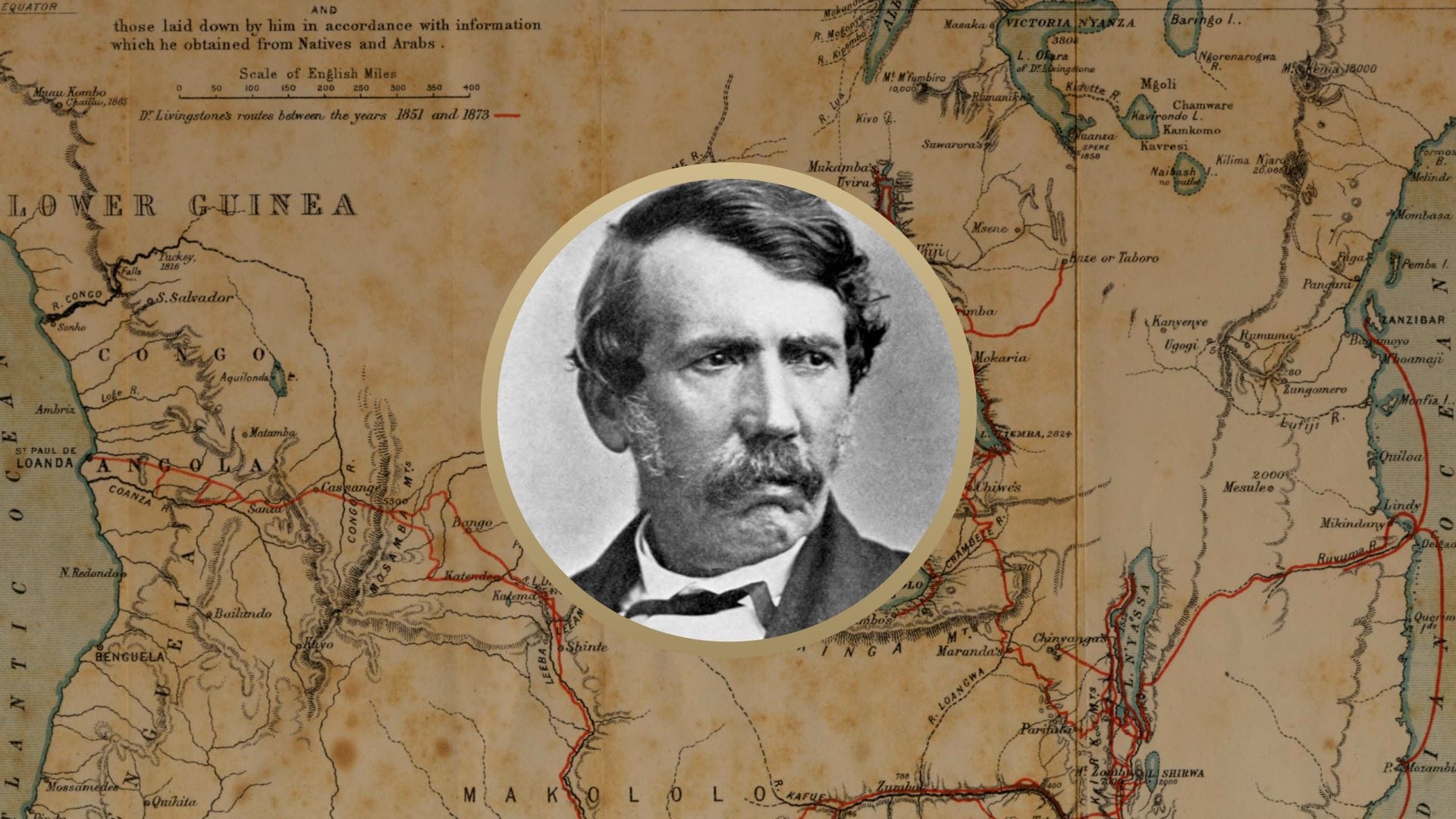
The prize made the eyes of the lad sparkle with anticipation. His Sunday School teacher had offered a New Testament to anyone in the class who would memorize Psalm 119, all 176 verses! The young boy had never done anything like this before, and he was only nine years old. Sure enough, by the required time, the boy stood erect on the stand and quoted the entire psalm with only five small errors. Little did that Sunday School teacher know that the name of his pupil, David Livingstone, would one day be known throughout the world and that he would carry this New Testament to places that were not even on the map.
But that adventure was for another day. Life for the young son of a poor Scottish clerk had to go on. When David Livingstone was ten, his loving parents had to put their son to work in a Scottish cotton mill.
The very first week of his employment, the boy purchased a grammar book. He sat for long hours at the spinning jenny, a hand-powered spindle machine for spinning wool or cotton. However, he always had a book propped up so he could read while his hands worked. In this way, the lad acquired his education. He would not read novels, considering them a waste of time, but he did devour every other book that he read.
Over the years, David Livingstone memorized large sections of the Bible. He read science and history. He especially liked to read geography and to learn about strange lands far from the hills of his native Scotland. When he was twenty years old, he openly confessed Christ and dedicated his life to the service of God.
Hearing an appeal for the benighted land of China, Livingstone began to prepare himself for that mission field. His heart yearned for the salvation of the throngs of people in the vast continent of Asia. In addition to theology, Livingstone diligently began to study medicine, which he knew he would need in ministering among the multitude of souls in mainland China. At the age of twenty-five, Livingstone applied to the London Missionary Society as a candidate for the mission field of China.
During this time, Livingstone also began to preach in the surrounding countryside churches in additional preparation for the mission field. One day, the pastor of a nearby village church suddenly became sick, and the missionary candidate was asked to come speak. Livingstone carefully prepared a sermon. When the time came to preach, he ascended the pulpit and dutifully read his Scripture text. But then, he suddenly could not remember his sermon, not a single word! He ruefully announced, “Friends, I have forgotten all I had to say.” With that statement uttered, he then fled from the church.
As a result of this disconcerting incident, distressing rumors began to circulate about him. Men in high places looked with disfavor upon the young man. Some said that his prayers were “not eloquent.” Others pointed to his general failure in the pulpit. The rumors came to the ears of the London Missionary Society. After discussing the situation, the group decided that David Livingstone would not make a good missionary. He was placed on probation.
In spite of these discouragements, Livingstone would not quit. Realizing his own failures, he sought to remedy them the same way he had memorized Psalm 119 and had read books while working at his spinning jenny. That remedy was diligent hard work.
Thus, the young man applied himself wholeheartedly to the study of medicine and theology and endeavored to do better in the pulpit. The London Missionary Society agreed not to dismiss him; they merely continued his probation.
Then came an unexpected turn of events. With the Opium War raging in China, that door of opportunity was temporarily closed to mission efforts. At the same time, a visiting veteran missionary came and spoke to the mission candidates. The seasoned missionary described another field, equally as important as China. “I have, at night, looked out from my mission station and seen the smoke of a thousand villages where Christ is not named.” From that moment, the heart of Livingstone, the aspiring missionary candidate, was fixed upon the new mission field—the land known then as “The Dark Continent.”
On November 20, 1840, David Livingstone was ordained as a missionary. He eagerly set sail for South Africa the next month and arrived at the Dark Continent in March 1841. From 1841 until his death in 1873, David Livingstone walked thousands of miles, taking the name of Christ to those villages on the continent. In 1845, he married Mary Moffet, the daughter of the missionary who had described those villages to him. Over the course of their marriage, the Lord blessed David and Mary with six children.
While in Africa, Livingstone discovered tribes never before recorded. Faithful to his calling, he introduced them to the God Who was the Creator of all things and the Redeemer of sinners. In his treks throughout Africa, he crossed the Kalahari Desert, and he cut his way through dense jungles and swam crocodile-infested streams. He traced rivers, such as the Zambezi, Shire, and Nile, to their headwaters. He discovered Mosioatunya Waterfall and renamed it Victoria Falls, after his queen.
The hardships of Livingstone’s youth had prepared him for the difficult trials of a pioneer missionary. He endured tropical illnesses, betrayals, discouragements, and injuries. For example, on one occasion, he met a huge African lion on the trail. Although he was well armed, his gun was no match for the powerful lion. With two bullets in his heart, the lion still had enough strength to seize and crush the missionary’s shoulder. For the remainder of his life, Livingstone had trouble with that shoulder. Yet another hardship he eventually had to bear was burying his beloved wife, as well as several of his children, in the soil of Africa.
Although he had no way of knowing, David Livingstone had become a national hero back home in the British Isles. The occasional letters that he had sent home were, unbeknownst to him, published in the London papers. Englishmen throughout the world began pulling out maps and tracing with their fingers those vast blank regions of Africa where he was carrying the Gospel of Jesus Christ. In 1856, when he returned to England for a visit, Livingstone was surprised to see a crowd of admirers thronging the wharf to catch a glimpse of him!
After that visit to England, Livingstone returned to Africa, the land that he had come to love. He plunged into the vast interior of the Dark Continent. No one heard from him for several years.
Eventually, a journalist/explorer named Henry M. Stanley was sent from New York to Africa to find out if the missionary was still alive. Finding a missionary on a continent was like looking for a needle in a very large haystack! But, beyond all hope, the journalist succeeded. The two men had never met before. Yet, upon finally finding the missionary deep in the African wilderness in what is now modern-day Tanzania, Henry Stanley asked simply, “Dr. Livingstone, I presume?”
The London Missionary Society was made famous by the candidate they had once criticized and considered dropping. All England had been awakened to foreign missions. All the while, David Livingstone had carried with him the New Testament he had won as a young lad through thousands of miles of vast and unexplored savannas, jungles, swamps, and mountains.
In 1873, an aging Dr. Livingstone set out on a long trek to find the headwaters of the Congo River. One morning, when his native companions came to check on their beloved leader, they found his stiffened body in a kneeling posture beside his cot. Dr. David Livingstone had died while on his knees in prayer, beseeching God to send forth more laborers into His harvest.
Dr. Livingstone’s body was embalmed and taken back to England. There it was received with all the honors due a hero. His remains were afforded the high honor of being laid to rest in Westminster Abbey. But before leaving the shores of Africa, at the request of the grateful natives among whom Dr. Livingstone had spent his life, his heart had been removed from his body and respectfully buried in the soil of Africa.
Sources and Further Reference:
Christie, Vance. David Livingstone: Missionary, Explorer, Abolitionist. Ross-shire, Scotland, UK: Christian Focus, 2023.


 21:37
21:37