

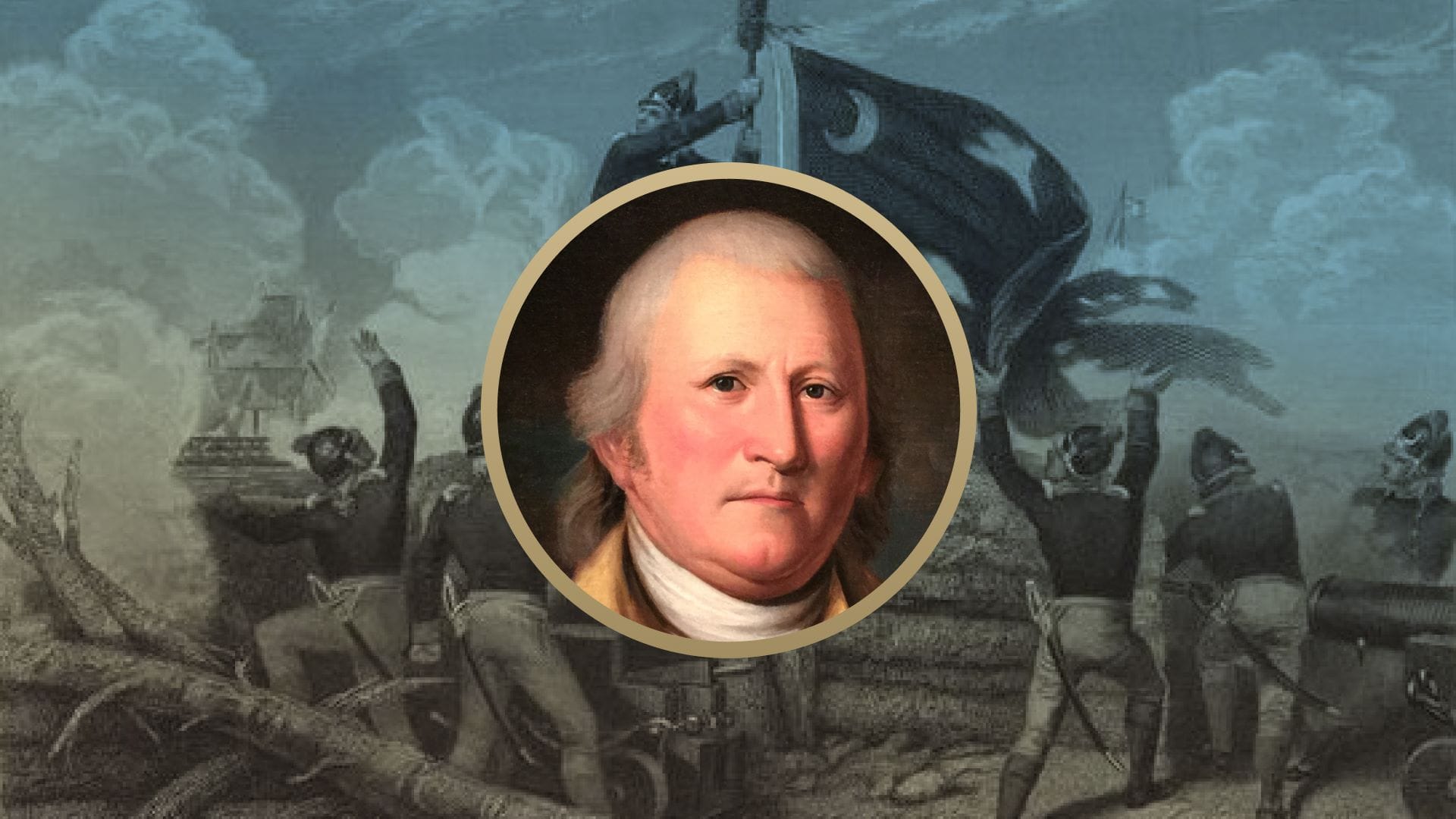
With an air of dubious apprehension and disdain, Major General Charles Lee looked around the makeshift fortress on Sullivan’s Island. The fort, instead of being built with sturdy masonry, was made of spongy palmetto logs and sand. The troops manning the walls were inexperienced and untested militia men. The fort’s position on Sullivan’s Island was a desperate one, with no clear avenue of escape should the fort come under naval bombardment.
Atop the fort flew a homemade blue flag with a crescent moon in the upper left-hand corner, the symbol of liberty adopted by the Second South Carolina Regiment of provincial troops. The militia colonel in command of the fort was a native of Charleston, William Moultrie. The contrast between the two officers, General Lee and Colonel Moultrie, could not have been greater.
General Lee was acclaimed by many to be the most experienced American officer. He had once held a commission in the British army and viewed himself as a wise and sagacious commander. He resented the position held by General George Washington; Lee considered himself best suited to be the commander of the American Continental Army! General Lee had been selected by Congress to command the Southern Department, and he had come to Charleston, South Carolina, to inspect the works that had been hastily prepared in the threat of a British attack by sea.
The other leader present that day, Colonel William Moultrie, was the son of a Scottish physician who was well respected in Charleston. Moultrie’s regiment of South Carolina militia was composed largely of the descendants of French Huguenots. They were brave, determined men, although they lacked experience and ordinary discipline. Moultrie was viewed by many as a lax officer, prone to indulge his men and give them what they wanted. He had recently lost his wife and was still grieving her death at the time of the British advance. Colonel Moultrie’s limited military experience was in expeditions against the Cherokee, and he had never come face-to-face with British regulars in a general engagement.
Moultrie had been placed in command of the Second Regiment and given the task of holding Sullivan’s Island against an expected British naval attack. After surveying the fort, General Lee took Colonel Moultrie aside privately and asked him if he really supposed that he could hold off the British fleet? The colonel replied, “Yes. I think I can.” General Lee, as well as Governor Rutledge, were not convinced. They urged Colonel Moultrie to prepare his militia for evacuation in the event of a British attack.
But Moultrie had not come to Sullivan’s Island in order to retreat. He ignored the request to make a bridge of boats to allow him to evacuate his troops. Instead, he steadily prepared his men to hold the fort to the last extremity.
On the morning of June 28, 1776, Colonel Moultrie was out on horseback when he saw a startling sight. In the early light of sunrise, the colonel observed that the British fleet anchored off the Charleston Bar had loosed their topsails! Galloping the three miles back to the fort, Colonel Moultrie hastily gave the order for every man to stand at his post of duty.
Meanwhile, Colonel Moultrie was unaware that General Lee, frustrated by Moultrie’s unwillingness to plan for a line of retreat, had given the order for Moultrie to be relieved of command that very day! He was to be replaced by another officer. But the order came too late. The attack was already underway.
Moultrie ordered the blue regimental flag to be lowered and raised again as a signal to the city of Charleston that the British fleet was advancing. The haughty British Naval Commodore Sir Peter Parker was so assured of success that he brazenly sailed his warships right alongside the palmetto fort! Then he began to unleash volley after volley at his target.
Heavy surf prevented the planned British amphibious assault. However, the British trusted the power of their big naval guns to batter the fort into submission.
Colonel Moultrie and his junior militia officers had never heard the roar of such guns before! But they soon became accustomed to the sound, and Moultrie gave orders to return fire. Although the American gunners had little experience with heavy artillery, they manned their guns with determination. Short on gunpowder, Moultrie gave orders that the American fire be slow and deliberate.
After two hours, General Lee sent word that Moultrie should spike his cannon and abandon the fort while there was still time. General Lee waited in consternation for the fort to be abandoned. But Moultrie was not considering retreat, and he stubbornly kept his post. When the blue flag with the white crescent was shot down from its staff, a courageous young sergeant, William Jasper, dashed outside the fort to retrieve the fallen colors. Tying the flag to a sponge staff (a big, long implement used to clean the inner barrels of cannons), Jasper climbed to the top of the rampart and defiantly lifted the flag to the breeze again.
Hour after hour the contest continued. To Colonel Moultrie’s delight and to Commodore Parker’s dismay, the spongy palmetto logs absorbed the British shells without splintering. Each shot was buried in the logs and the sand, and the fort held. As for the defensive position results, American fire was well directed toward the British warships and had good effect.
At one point during the battle, British Naval Commodore Parker was wounded in his upper leg and knee. He suffered the indignity of having the hind part of his breeches entirely shot away!
Finally, General Lee ventured out to the fort to take a personal inspection and to reprimand Colonel Moultrie for not withdrawing his garrison. He was astonished as he looked around the fort and saw the bravery of the American militia and the calm deportment of Colonel Moultrie. General Lee stayed at the fort for only fifteen minutes. Upon departing, he said, “Colonel, I see that you are doing very well here. You have no occasion for me; I will go up to town again.”
Fort Sullivan was renamed Fort Moultrie, and the militia colonel was honored by the thanks of the Continental Congress. He was eventually promoted to Major General in the regular Continental Army and was a vital player in the eventual victory of the cause of liberty.
Later, General William Moultrie was elected governor of the independent state of South Carolina. He led his native state in peace as he had led her in war. His published memoirs became one of the leading sources describing the American Revolution in the South. Moultrie became the first president of the Society of the Cincinnati in the state of South Carolina and served in that capacity until his death.
The current flag of South Carolina, combining the crescent moon and the palmetto tree, is a reminder of what a few brave men can do under the blessing of the Almighty. Unwilling to retreat in the face of the darkest odds, Colonel William Moultrie achieved a resounding victory and set an example of hope and courage to his countrymen.
Sources and Further Reference:
Bragg, C. L. Crescent Moon over Carolina: William Moultrie and American Liberty. Columbia, SC: University of South Carolina Press, 2013.



 21:37
21:37