

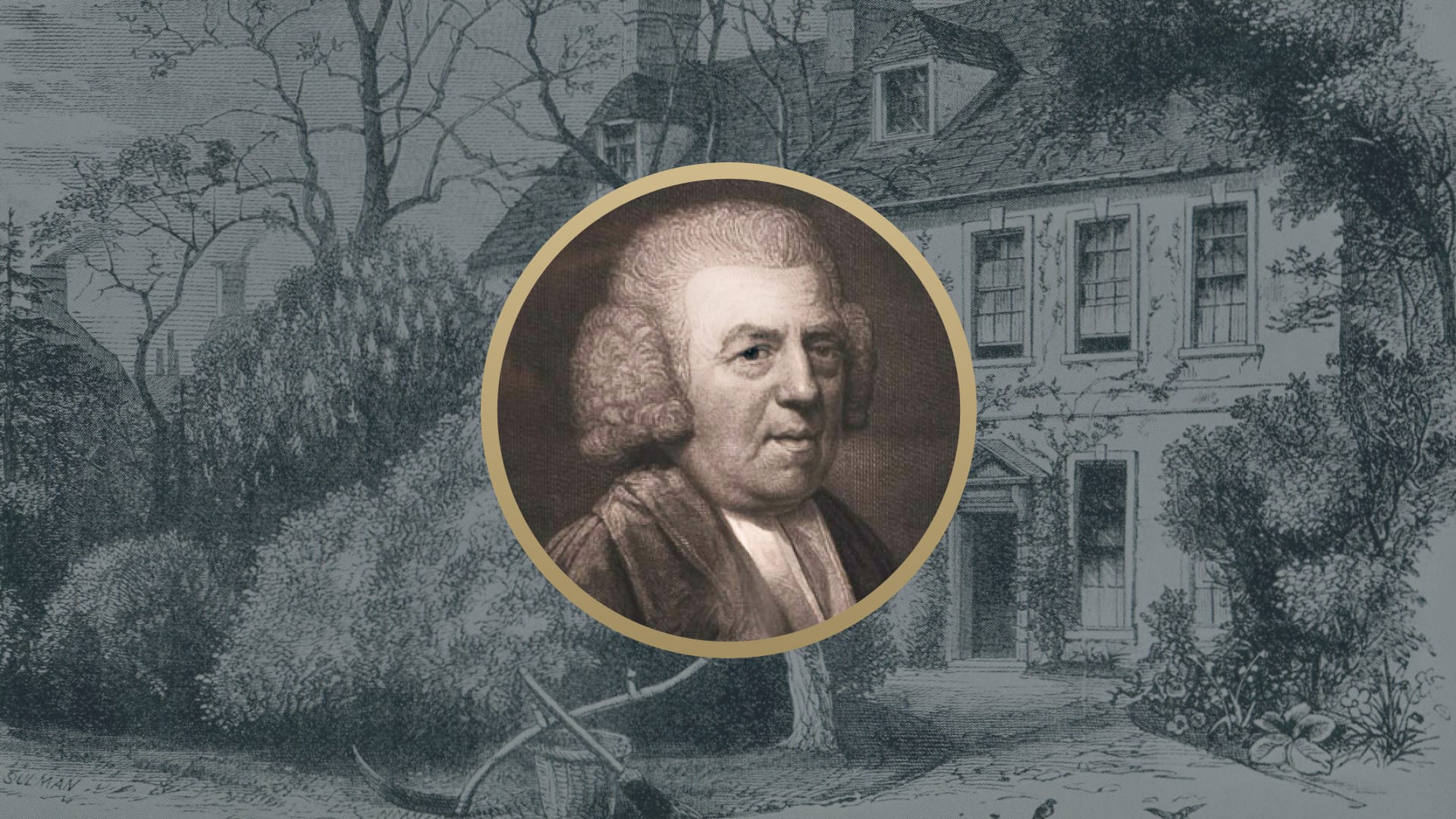
No hymn has earned such a lasting place in the collective memory of humanity quite like “Amazing Grace” by John Newton. The words and expressions of a sinner saved by grace can be echoed in every heart by men and women of every ethnic background and creed, bound together by a common need for the grace of God.
Amazing grace (how sweet the sound)
that saved a wretch like me!
I once was lost, but now am found,
was blind, but now I see.
This beloved hymn is largely autobiographical, tracing the life and spiritual experience of John Newton, but Newton wrote the hymn in such an expansive way that its truths can be applied to every human heart burdened by sin and thirsting for grace.
John Newton was born on July 25, 1725, almost 300 years ago. John’s mother, Elizabeth, was a pious and Godly Christian who taught her son the Scriptures at a very early age. The Word of God was deeply rooted in his heart. Elizabeth Newton slowly died of tuberculosis; John lost his mother at the early age of seven. But God’s Word never returns void.
At the age of eleven, Newton first went to sea with his father, a sea captain operating in the Mediterranean Sea. Life around ungodly sailors hardened the boy in his teen years. He learned to curse his mother’s God. After his father retired from active service, the teen lost all parental restraint and became as ungodly, immoral, and intemperate as his peers.
When Newton was eighteen years old, he was pressed unwillingly into the service of the Royal Navy. He detested service in the Navy and tried to desert. But the deserter was caught, stripped, and flogged mercilessly. Newton wanted to murder the captain and then kill himself, but he was restrained by the hand of grace. Under the influence of infidels, John Newton eventually renounced the doctrines of Christianity and openly engaged in immorality and all sorts of vice.
Often, during dark periods of discouragement and gloom during these years of sin, the Scripture his mother had taught him surfaced in John’s mind. He suppressed the truth in unrighteousness; moments of good intentions then vanished in the face of temptation. He began serving aboard slave ships, purchasing slaves from the coast of Africa and selling them to Europeans and Americans.
While aboard the Pegasus, a slave ship cruising along the western coast of Africa, the slave dealer took the troublesome Newton on shore and gave him to his wife, a proud and haughty African princess. John Newton, now a possession of the princess, felt what it was like to be a slave himself, despised and scorned by his owner.
Three things kept Newton’s hope alive. First was the lasting influence of his mother’s prayers and Scripture lessons. Second was the knowledge that his father still loved him. Third was the cherished hope he had of marrying his childhood sweetheart, Mary Catlett, back in England.
By God’s grace, Newton’s father had requested a friend of his, a fellow sea captain, to find his lost son. The sea captain inquired and found John Newton, rescuing him from slavery and giving him passage home on his merchant ship, the Greyhound.
During the voyage, the Greyhound was hit by a savage storm near the coast of Ireland. The ship began to take on water. Newton, like Jonah of old, felt that the storm was sent by God to awaken him from his sinful rebellion. In the midst of the raging wind and furious sea, John Newton, the sinner and slave trader, cried out to God for grace.
’Twas grace that taught my heart to fear,
and grace my fears relieved;
how precious did that grace appear
the hour I first believed!
The ship carrying Newton was brought safely to land in March 1748. The penitent, redeemed young man became a diligent student of the Bible. He knew that he was a wretch, undeserving of the least of God’s favor. Yet, the amazing grace of God continued to draw his heart over the course of the next several years. John Newton went back to sea later that same year. In 1749, he became a sea captain himself, dealing in slaves. Newton gradually became convinced from Biblical passages such as Deuteronomy 24:7 that “man-stealing” was wrong, and he later wrote a book titled Thoughts Upon the African Slave Trade. This book exerted an influence upon the eventual ending of the British slave trade.
Through many dangers, toils and snares
I have already come:
’tis grace has brought me safe thus far,
and grace will lead me home.
That next year, in 1750, John Newton married his childhood sweetheart, Mary Catlett. He and Mary never had children of their own, but they did adopt two nieces who were orphaned. The couple cared for both girls as though they were their own.
The Lord has promised good to me,
his word my hope secures;
he will my shield and portion be
as long as life endures.
John Newton suffered a stroke in 1754. He gave up the life of a sea captain and felt the Lord leading him toward the Gospel ministry. He studied Greek, Hebrew, and Syriac, and cultivated friendships with John Wesley and George Whitefield. John Newton also became a very close friend of William Cowper, also a prolific hymn writer.
In 1764, Newton was ordained and installed as pastor in Olney. He faithfully served the congregation there for many years. William Cowper became a member of his congregation. During his ministry at Olney, John Newton wrote many of his best hymns, including “Glorious Things of Thee Are Spoken” and “How Sweet the Name of Jesus Sounds.”
On December 21, 1807, John Newton died. He was tired, sick, and almost blind. Despite physical weakness, his previously penned words expressed his redeemed heart’s hope and expectation:
Yes, when this flesh and heart shall fail,
and mortal life shall cease:
I shall possess, within the veil,
a life of joy and peace.
John Newton spent his life testifying of the grace of God to save a sinful wretch as he was—a sinful wretch such as each one of us is.
Someday, life as we know it will end. The earth will be dissolved, and the sun will cease to shine. But the amazing grace of God will never fail!
The earth shall soon dissolve like snow,
the sun forbear to shine;
but God, who called me here below,
will be forever mine.
Sources and Further Reference:
Cecil, Richard. John Newton. Fearn, UK: Christian Focus Publications, 2000.

 22:09
22:09