
In the life of Lydia, who was noted in Acts 16:14 as a “seller of purple,” we find an example of a woman who knew what it meant to go the second mile in the service of her Lord. She lived a holy life in an unholy world and set an example for many generations of Christian women throughout history to follow.
Lydia is first mentioned in Acts 16. At this point in the record of Acts, Paul had already been on his first missionary journey and had just received the vision of the man of Macedonia saying, “Come over into Macedonia, and help us” (Acts 16:9). Thus, in Acts 16:12, Paul is recorded as arriving in Philippi, where his path would soon cross Lydia’s.
Philippi was an ancient city inhabited by the Thracians. In 358 B.C., the city had been conquered by Alexander the Great, and he named it after his father, Philip of Macedon. Greek culture had then been infused into the city, changing Philippi forever. Later, Augustus Caesar made the ancient Greek city a Roman colony.
Philippi was a strategic crossroads. It was near the seaport of Neapolis, and thus a city well situated for sea trade. But Philippi was also a principal city on the great Egnatian Way, a highway that ran from Rome to Byzantium.
According to Acts 16:12, this city was a “colony,” meaning a Roman colony. Philippi was known as a retirement center where many retired military officers lived with their families. Thus, the city, full of retired soldiers, was a pagan mix of Greek and Roman elements and of a very large population.
Into this great city of Philippi, Paul entered with his company. There were no inns to welcome them. There were no Christians to receive them. There was, for the first time in Paul’s travels, not even a Jewish synagogue! The city was busy, prosperous, and entirely pagan.
Luke recorded his first-person account of what happened next: “And on the sabbath we went out of the city by a river side, where prayer was wont to be made; and we sat down, and spake unto the women which resorted thither” (Acts 16:13).
At that time, ten Jewish men were required in order to form a synagogue. Apparently, there was not one Jewish man or even a male proselyte in all Philippi, even with its vast population! This city with no synagogue was the first Paul had ever been in. The only “synagogue” he and his companions could find was a group of women, probably primarily composed of Gentile proselytes to the Jewish religion. They were meeting to pray at the riverside on the Sabbath. Rivers were needed for the ritual washings and baths that Jewish custom required in the time of Christ and the apostles. Thus, these women assembled near the Gangitus River, in Philippi.
Lydia is introduced by name in Acts 16:14–15. “And a certain woman named Lydia, a seller of purple, of the city of Thyatira, which worshipped God, heard us: whose heart the Lord opened, that she attended unto the things which were spoken of Paul. And when she was baptized, and her household, she besought us, saying, If ye have judged me to be faithful to the Lord, come into my house, and abide there. And she constrained us.”
The first recorded converts in Europe were these souls of the household of Lydia. While her family situation is not known, we do know from her profession that she was in the upper social strata of life. She was originally from Thyatira but had apparently come to Philippi to practice her trade of selling purple.
Apparently, she had no living husband, but she did have a household that most likely included bondslaves. The evidence seems to indicate that Lydia was probably a widow with a few children and some servants. She, her children, and her slaves believed that day and were baptized as an open testimony that all their pagan ways and the false religion of youth were behind them, under the blood of Christ. Onward from the moment of Lydia’s baptism, she would obey Christ Jesus.
Clearly, God had closed the door to ministry in Asia. It appears He did so in order to reach an earnest soul. Luke recorded that Lydia’s first act as a baptized believer was that she besought (“earnestly begged”) the missionaries to accept her hospitality.
In the first century, it was considered impolite to readily accept an invitation. The polite practice was to give your host the privilege of constraining you to accept his hospitality. Just as Abraham insisted on hosting the three Heavenly visitors for a meal, so now Lydia insisted that Paul, Luke, Timothy, and Silas come abide at her house.
In Biblical times, hospitality was considered not only a privilege but a sacred duty. Lydia, willing to show her new Christian love and charity, opened her home to Paul and his missionary team. This was not a light invitation! Houses were not large in those days, even for the upper strata of society. To extend hospitality to five travelers would require much. For Lydia to open her home to them required great sacrifice.
Yet, Lydia was willing to go the second mile in her newfound faith. She not only had believed in the Gospel and been baptized, but she further opened her home to become the center of evangelism for the pagan city of Philippi!
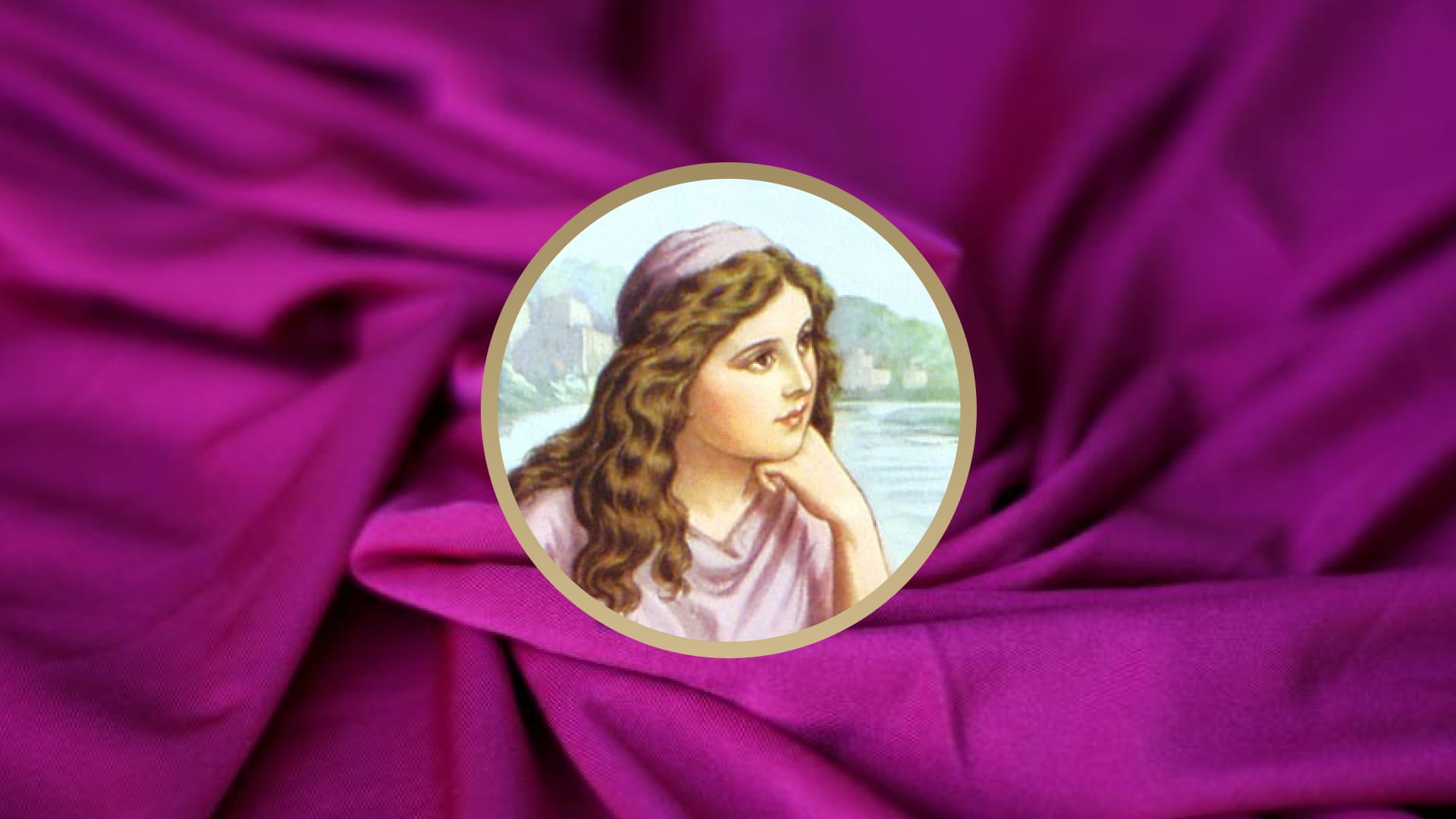
As for her trade, purple cloth was for the elite. In fact, it was the required material for the official Roman toga. Purple dye was produced in Lydia’s hometown of Thyatira. The highest quality purple dye was extracted from the murex shellfish; the dye was both rare and expensive. Lydia probably did not make the material nor collect the shellfish. More likely, she would have been one who dyed the cloth and sold the fabric.
Perhaps she had moved to Philippi from Thyatira so that she could be closer to the main highway to Rome and closer to the demand for purple. In a Roman colony with Roman officials and travelers, the business would have been brisk and prosperous. Who were her customers? They were the Roman colonial rulers, the magistrates of the city of Philippi. These are the souls she had contact with—people whom Paul could not even gain access to. Yet, Lydia met and dealt with the upper class every day. Thus, her Godly influence was felt even in the upper echelons of Roman society!
While in Philippi, Paul and Silas were followed daily by a “damsel possessed with a spirit of divination” (Acts 16:16). When they commanded the demon to depart in the name of Jesus Christ, the superior power of the Holy Spirit angered the girl’s masters who had earned money by her divination. As a result, these wicked men stirred up a mob, dragged Paul and Silas before the magistrates, and there the two disciples were beaten and cast into prison. That night Paul and Silas did not return to Lydia’s home, where it is assumed that Timothy and Luke were safely lodged.
After Paul and Silas were beaten and the subsequent conversion of the Philippian jailor, the two missionaries returned to Lydia’s house according to Acts 16:40. “And they went out of the prison, and entered into the house of Lydia: and when they had seen the brethren, they comforted them, and departed.”
After Acts 16:40, Lydia fades from the pages of Scripture. Her name is never mentioned again, but her influence continued. Who nourished the church of Philippi? Who influenced the church to become the most generous church of the New Testament, noted again and again in Scripture for its generous gifts sent to Paul? Paul commended this maturing church regarding their generous giving in a later epistle: “Ye have done well, that ye did communicate with my affliction. . . . no church communicated with me as concerning giving and receiving, but ye only. For even in Thessalonica ye sent once and again unto my necessity” (Philippians 4:14–16). Would not Lydia have played an important role in the ongoing ministry in Philippi?
Today, the church of the Lord Jesus Christ still needs women like Lydia—generous Christians whose hearts have been opened to love and advance His Kingdom. Lydia was willing to go the second mile, not only to believe in the Lord Jesus, but also to sustain the advance of the Gospel through her hospitality, prayers, and generous and consistent giving. May God help us to do the same.