
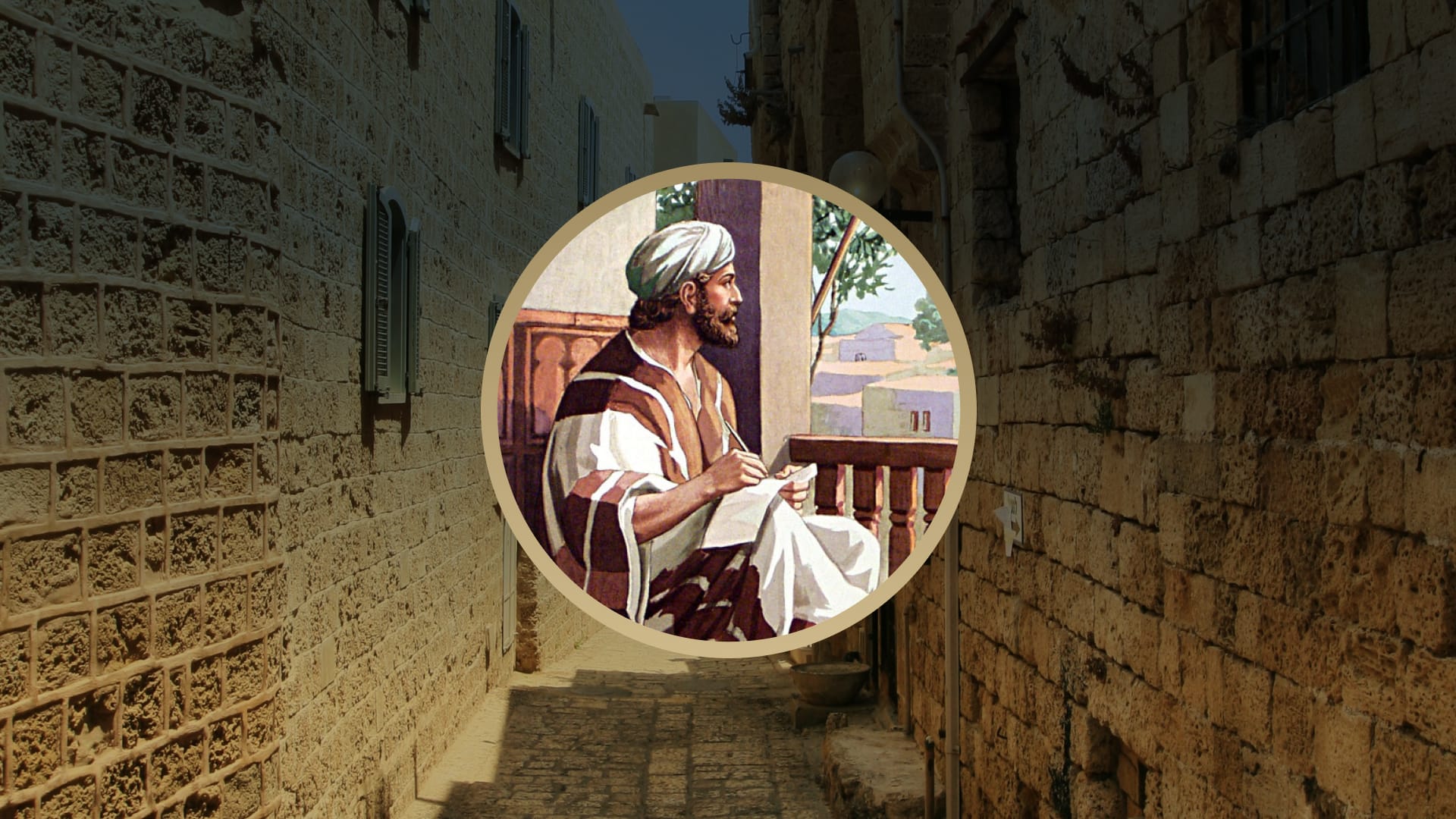
In Matthew 9:9, we read the first salvation testimony in the New Testament. It is the written record of the conversion and call of Matthew the Publican, from the pen of the man himself. According to this Scripture passage, “And as Jesus passed forth from thence, he saw a man, named Matthew, sitting at the receipt of custom: and he saith unto him, Follow me. And he arose, and followed him.”
The important point about Matthew is that he followed Jesus. Little to nothing is known about the man’s life before this moment, and very little is known about his life afterward. But we do know that he heeded the call and followed Jesus.
It is interesting that the other Gospel writers, also called the Evangelists, did not call Matthew by the extremely degrading and humiliating title of “publican.” Mark, Luke, and John usually called him simply “Matthew.” They also sometimes used his other name, “Levi,” or at other times referred to him by the name of his father, as in “Levi the son of Alphaeus.” But Matthew, in his own list of the twelve disciples as recorded in Matthew 10:3, called himself what he was—“Matthew the publican.”
The call of Matthew occurred sometime during Christ’s early Galilean ministry. The place of his call was near Capernaum. The time was shortly after Christ had healed the paralyzed man who was lowered from the roof by his friends while he lay upon his stretcher.
Publicans were the despised collaborators with the hated Roman officials. When it came to collecting taxes, publicans had various ways of doing so. In collecting revenue, Roman roads were a prime place for a tollbooth to be set up so travelers could pay for the use of the road. The Roman government had built the magnificent road system of the first century at its own expense and by the manpower of its legions. Roads were used to shuttle armies quickly from one theatre of operations to another. Supremely engineered, many of these roads still exist in good condition to this very day.
Some of the most important roads in Israel ran through the Capernaum area. Capernaum was, in fact, a crossroads, or a hub, where several important highways intersected. One major road came up from Egypt, the famous Via Maris (“Way of the Sea”). Since there was no good way to cut a road through the Carmel ridge, the Via Maris swung inland several miles to the shore of the Sea of Galilee and passed through Capernaum toward Damascus, a center of overland trade by caravan.
Northwest from Capernaum, another road lay toward the great Phoenician cities of Tyre and Sidon, the twin cities of maritime trade. To the south ran the ridge road; it skirted the western shore of the Sea of Galilee and then went through the hills of Samaria toward Jerusalem. To the southeast, another road ran to the cities of the Decapolis and skirted the eastern shore of the lake, then followed the Jordan River south to Jericho. All of these important roads passed through Capernaum.
Apparently, Matthew was at his accustomed post at the tollbooth, collecting taxes, when Christ came to him with His life-changing command: “Follow me.” The moment was startling, not only for Matthew, but for everyone standing around. Publicans were not often commanded! Instead, they typically gave commands. But at this moment, Jesus, a carpenter from Nazareth, was giving the orders.
Usually, the local garrison of troops had guards stationed at the tollbooths to enforce payment and guard the money. Matthew would have been well-protected. But Christ ignored the guards, ignored the opinions of others, and said, “Follow me.”
To follow Christ was no light decision for Matthew. To do so, he would not merely leave behind his seat at the tollbooth. He would have to leave behind that well-stocked money chest. He would leave behind the protection of the Roman guards. He would leave behind the walls that he and others of his profession had built around themselves. Publicans could associate only with publicans. By rising from his seat to follow the Lord Jesus, Matthew would give up wealth, security, pleasure, his future, and eventually, as we shall see, his very life.
Soon after accepting the call of Christ, the newly converted disciple invited his new Master to his home. A banquet was prepared. Matthew in his own account did not name the host out of modesty. However, from the account in Luke’s Gospel, clearly the reception was at the home of Matthew, also called Levi in parallel passages. According to Luke 5:29, “And Levi made him a great feast in his own house: and there was a great company of publicans and of others that sat down with them.”
It was a great cultural offense to patriotic Jews (Pharisees) to have any dealings with publicans. The Pharisees were always on hand to criticize every deed and cast a slur upon the name of Jesus. In response to the murmuring of the Pharisees at this feast, Jesus said, “They that be whole need not a physician, but they that are sick. But go ye and learn what that meaneth, I will have mercy, and not sacrifice: for I am not come to call the righteous, but sinners to repentance” (Matthew 9:12–13). It was for souls such as Matthew’s that Christ had come into the world.
After his conversion, Matthew was changed from a “taker” into a “giver.” This converted publican is not known for anything significant that he did or said during Christ’s earthly ministry. He was not prominent as his fellow disciples—Peter, Andrew, James, and John—were. Aside from the account of his call and this banquet, we do not have a record of a single thing that Matthew did or said. He is mentioned only in the several lists that named Christ’s disciples.
However, Matthew has the honor of being the first evangelist, and his name is attached to the first book of the New Testament. Matthew seemed to take special care in recording matters that concerned money and giving. After all, Matthew was a tax collector by profession. He recorded the event when Jesus and Peter paid their tribute money from the provision found in the mouth of a fish. He gave a careful account of Jesus’ words in the Sermon on the Mount that related to the giving of alms, laying up treasures in Heaven, and trusting God to provide for physical needs.
Perhaps when Matthew recorded Jesus’ words, he was thinking of his own pile of gold that he had left behind that day in Capernaum. “Lay not up for yourselves treasures upon earth, where moth and rust doth corrupt, and where thieves break through and steal: But lay up for yourselves treasures in heaven, where neither moth nor rust doth corrupt, and where thieves do not break through nor steal: For where your treasure is, there will your heart be also” (Matthew 6:19–21).
If there was ever a man who fulfilled this command of Christ, it was Matthew the Publican. Up until the moment when Jesus said, “Follow me,” Matthew had spent his life laying up treasure on earth. However, upon hearing the call of Christ, from that moment on by his own account, Matthew “arose and followed him” and spent the rest of his life laying up treasure in Heaven.
It is not entirely clear what Matthew did for the remainder of his life. The ministry of Matthew is not recorded in the Book of Acts. The record we have of Matthew, aside from his Gospel, is only a few scattered fragments from early church history.
Most historians, including the worthy John Foxe, conclude that Matthew labored in the land of Ethiopia and there preached faithfully the Gospel of Jesus Christ. In the land of Ethiopia today, there are still Christians laboring and serving where Matthew once preached, and these believers still remember with gratitude the life and testimony of Matthew the Publican.
Under King Aeglippus of Ethiopia, Matthew obtained a measure of royal favor and was at liberty to preach the Gospel freely. But upon the ascension of Hytacus, a cruel heathen, to the Ethiopian throne, Matthew was apprehended for persecution by the royal guard.
Matthew was ordered to be killed in a most cruel way. In the Ethiopian city of Nadabah, around A.D. 60, the king decreed that Matthew the Evangelist be tortured by nailing him to the ground with heavy spikes. Finally, a halberd, a cross between a broad axe and a pike, was used to put him to death. Matthew faithfully followed his Lord, all the way to the end of his life.