

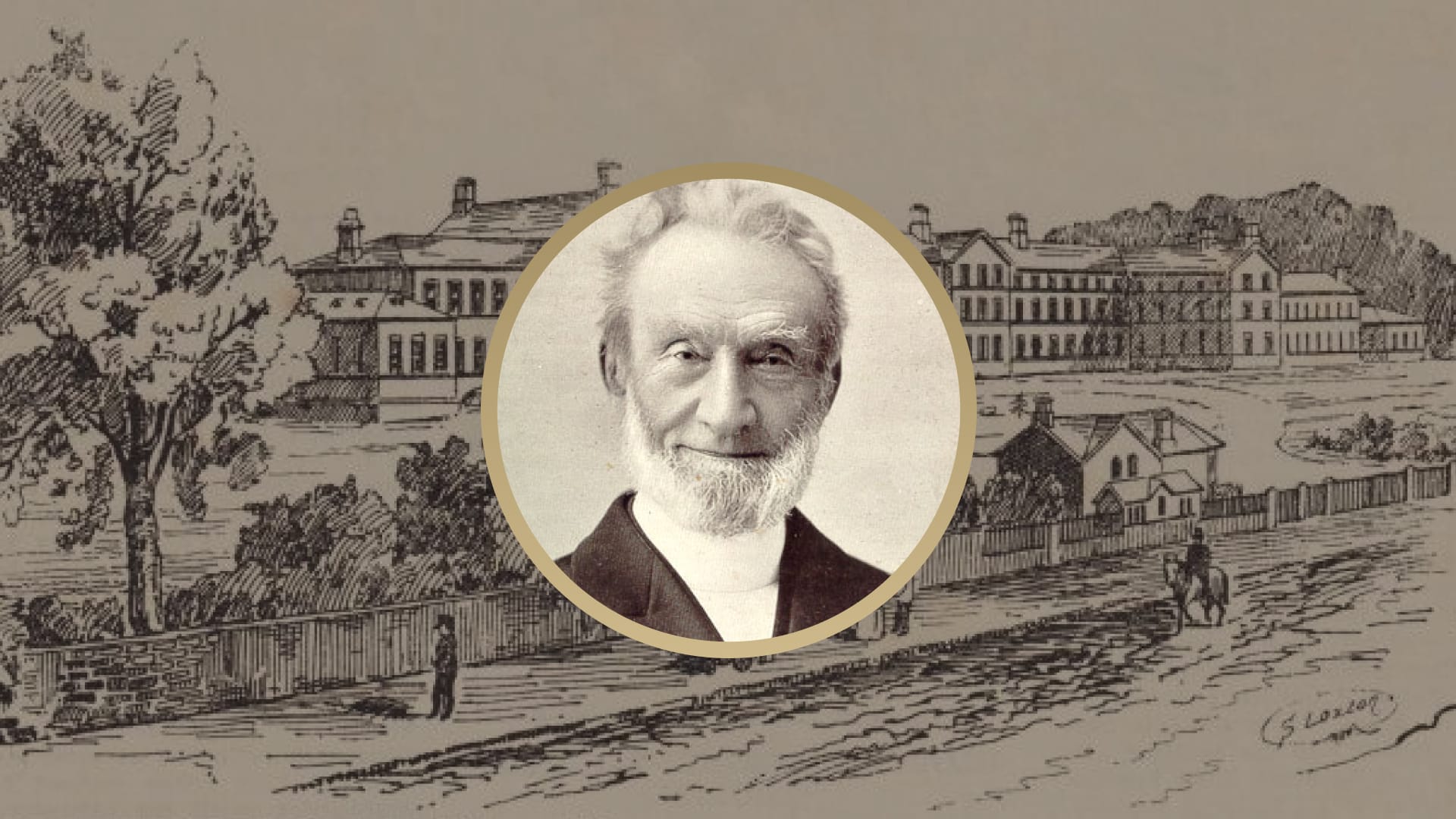
“Pure religion and undefiled before God and the Father is this, To visit the fatherless and widows in their affliction, and to keep himself unspotted from the world” (James 1:27). Many know this verse in the Bible, but few have acted upon it so fully and faithfully as George Müller.
At the turn of the nineteenth century, a sad, pitiful situation was outwardly evident on the streets of the major cities in England. On those cobbled streets, roving bands of orphaned children begged and stole their way through life. Many of them wore rags since they had little else to wear. They had nothing to eat except what they could scavenge or steal.
These homeless waifs sometimes would hold empty tin cups at the busy street corners, hoping that some kind gentleman or lady passing by might drop a shilling or two into the cup. When this approach failed, these hungry children resorted to picking pockets in the bustling marketplace. On cold winter nights, many of these pitiful children perished in the corners of the dark alleys. In the morning, street workers would come and collect the stiff little bodies into wheelbarrows. The deceased ones, unknown and unloved, were then taken and buried in unmarked graves.
There was a reason for all these poor orphans on the British streets. First, the Napoleonic wars in Europe were devastating. The conflicts brutally wiped out a generation of young men. Many fathers had been killed on the battlefield, leaving behind destitute families. Second, before the understanding of germ theory and antibiotics, many women died from complications in childbirth. Thus, there were an overwhelming number of orphans in Europe.
Most people viewed the orphan question with some degree of compassion, but few cared deeply enough to actually do something about it. Similar to the priest and the Levite in the story of the Good Samaritan, most European Christians passed by on the other side of the street. The same is still true today. Too often many church-goers are comfortable in their personal lives, but rarely see the deeper needs around them in society where children are labeled as “unwanted” or considered a bothersome obstacle to a life of pleasure.
However, in the nineteenth century, one German-born pastor and his wife could not simply pass by while orphans died by the hundreds in the streets. Like the Lord Jesus in Galilee, George Müller was “moved with compassion” and sought to minister to their needs. But this was not always the case. Few who knew George Müller as a boy would have ever thought that he would become a man who would provide a home for hundreds of orphaned boys and girls.
George Müller was born on September 27, 1805, in the village of Kroppenstedt in the Kingdom of Prussia, a kingdom that is now a part of Germany. Müller’s father was a local tax collector for the government. Young George learned to lie, steal, play cards, and drink, and by the age of ten years old, he had learned to steal money from his father! His mother died when he was fourteen, and soon thereafter he found himself in the clutches of what he himself called “wicked behavior.” George Müller eventually was sent to prison for a time. The young man seemed destined for a life of crime and violence. But he testified that “God had mercy on me.”
In 1825, when he was twenty years old, Müller was invited by a friend to attend a Bible study and prayer meeting at the University of Halle. Müller was convicted of his sins and turned to the Lord Jesus Christ in repentance and faith. As a new convert, he took very seriously the words of the Lord Jesus to sell what you have and give to the poor. Aware that he had been a selfish thief, he sold his possessions and gave the proceeds to the poor.
George Müller met a like-minded young woman in Miss Mary Groves. The two were married only three months after their acquaintance! The Lord blessed the couple with four children. Sadly, two babies were stillborn, and their son Elijah died from pneumonia in his youth. Only their daughter Lydia lived to maturity.
George and Mary Müller were asked by a dear friend to come across the English Channel and assist in the ministry at Bethesda Chapel in Bristol. The couple moved to England in the spring of 1832. There they assisted in the distribution of Bibles and tracts throughout Bristol. They invited children to Sunday Schools where they were taught from the Bible on Sunday afternoons.
Four years later, in 1836, the Müllers felt led by the Holy Spirit to begin a ministry of practical care and provision for the orphans that crowded the streets of Bristol. The couple started by taking in thirty orphan girls into their own rented home on Wilson Street in Bristol.
The Lord blessed the work mightily! Unsolicited gifts began to pour in from interested friends of the Gospel who learned of George Müller’s work with the orphans. Over the next decade, the number of orphans increased from 30 to 130, and four furnished houses along Wilson Street housed the orphans.
After years of prayer and labor, a separate building was constructed at Ashley Down in Bristol. This building would become a permanent orphanage. Throughout all of these years, Müller never once solicited financial support. He was a man of prayer, who believed that God would take care of the orphans that He loved. Jesus said to His disciples in the Upper Room, “Hitherto have ye asked nothing in my name: ask, and ye shall receive, that your joy may be full” (John 16:24).
George Müller believed God and took Him at His Word. For example, one morning at the orphanage, Müller stood at the front and viewed rows and rows of empty plates before hungry children who were ready for breakfast. There was no food in sight. Then Müller prayed. He thanked God for providing food for His children. The seated hungry orphans looked around, wondering what food?
Meanwhile, as Müller was praying, the milkman’s cart broke down in front of the orphanage, and the baker also at that moment came to the door. Soon bread and milk were abundantly supplied to all the marveling, grateful children! Similar miraculous answers to prayer occurred not once, not twice, but dozens of times!
Over the course of time, extending long after George Müller’s death, over 18,000 children were spared from misery, poverty, and death by the life-giving power of the Gospel. Müller received and used over one million British pounds, which is almost equivalent to $120 million in today’s terms.
George Müller had a deep, abiding interest in preserving life and light all throughout the world. He was an admirer of Hudson Taylor and regularly supported the advancement of the Gospel in China.
After the death of his first wife, Mary, Müller later remarried, this time to Miss Susannah Sanger, who was also an excellent helpmate. Once he had successfully passed the care of the orphanages to his daughter and son-in-law, George and Susannah Müller embarked on a seventeen-year global mission trip. That trip eventually took the couple to forty-two countries around the world, spreading the message of the Savior Who gives life and hope to those that sit in darkness.
When George Müller died at the advanced age of ninety-two, the entire city of Bristol paused to honor his memory and his influence. Two thousand orphans were among those who lined the streets as his body was brought to its resting place to await the resurrection. These boys and girls knew that they enjoyed the blessings of life because George Müller took seriously the invitation of the Lord Jesus to ask in faith and receive all that God intends to bestow.
Sources and Further Reference:
Pierson, Arthur T. George Müller of Bristol. Oak Brook, IL: Institute in Basic Life Principles, 2009.


 37:39
37:39