
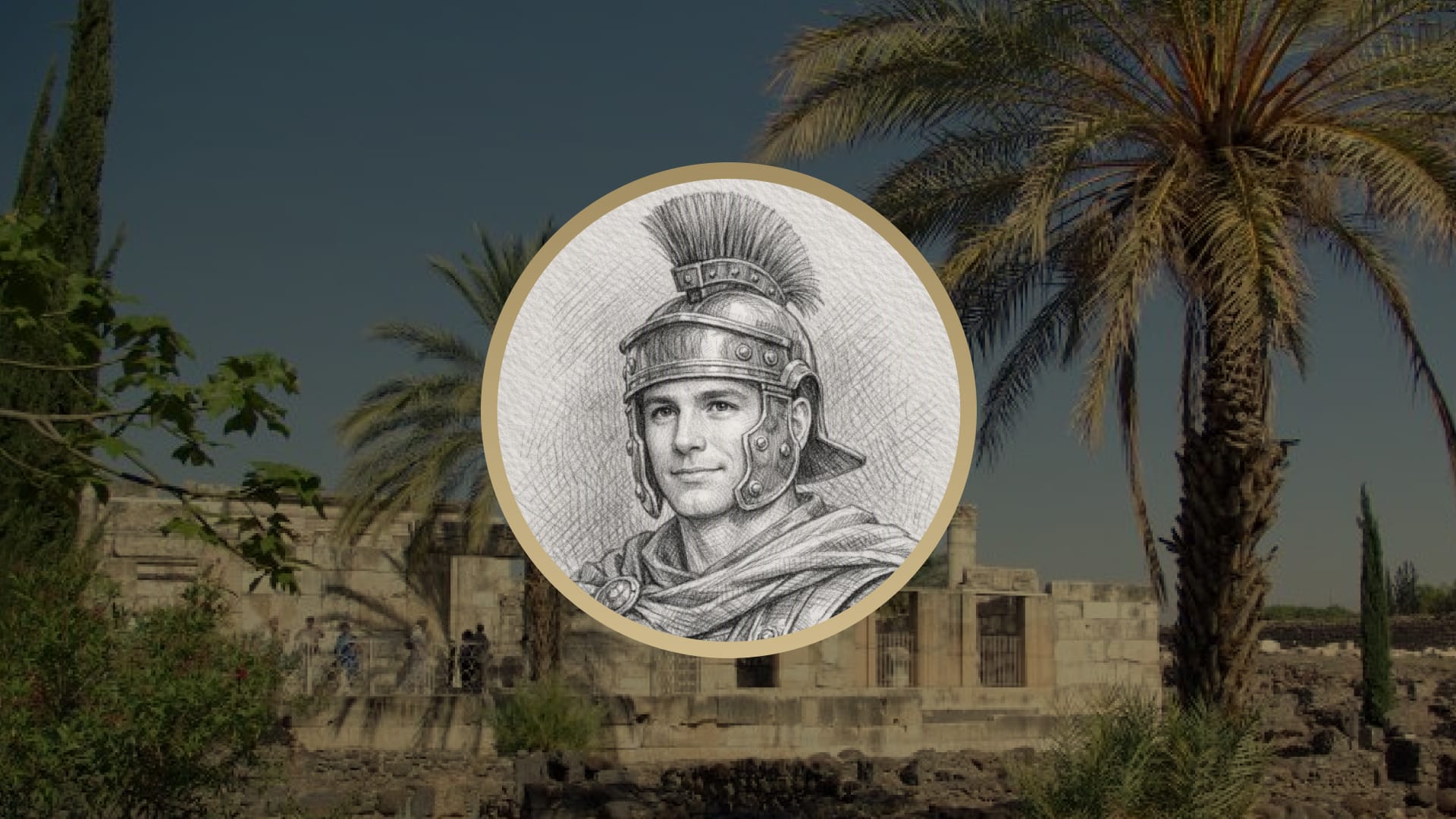
The man we examine in this article was a most unusual disciple of Jesus. He was a commanding officer in the Roman army—one of the last people one would expect to find as a devotee to a Jew from Nazareth. Roman officers were typically considered to be tough, independent, proud, and self-reliant. But this Roman centurion in Capernaum received one of the highest commendations from the lips of Christ. Jesus said of this man, “I have not found so great faith, no, not in Israel” (Matthew 8:10).
To consider this centurion and his interaction with Christ, it is important to understand a little about the structure and organization of the Roman army. Having conquered the known world at that time, Rome ruled her far-flung empire and patrolled her extensive road system through the power of her legions.
The centurion at Capernaum was probably the garrison commander for the century, a company of 100 men, who were posted there to guard the important road intersection on the north shore of the Sea of Galilee. Meanwhile, he also had to be on guard against the zealot stronghold at Gamla, just a few miles northeast of Capernaum. This station at the Jewish town would have been a post of trust, showing the Roman army’s confidence in this centurion. Being at Capernaum was an important detached command post.
Of the seven Roman army officers mentioned in the New Testament, all of them were honorable men. The account of this particular Roman centurion is recorded in Matthew 8:5–13, and there is also a parallel account in Luke 7:1–10.
Christ met this centurion in Capernaum during His major Galilean ministry and at the peak of His earthly ministry. Jesus had just recently given His Sermon on the Mount on a hillside above Capernaum. Next would be the meeting of the Roman centurion and the Son of God. “And when Jesus was entered into Capernaum, there came unto him a centurion, beseeching him, And saying, Lord, my servant lieth at home sick of the palsy, grievously tormented” (Matthew 8:5–6).
Notice how this worthy, commanding Roman centurion approached Jesus, a Jew. The great soldier came to Christ very humbly. He did not issue a demand. He did not give an order as a military man could do. No. He “beseeched him.” The centurion called Christ “Lord.” The commander’s words were consistent for a military man with an understanding of authority.
Having addressed the Lord Jesus with respect, he then submitted his request. He came not with a request for himself. It was for his servant. The Greek word here used for servant simply means “boy.” This Greek word has a very wide range of meaning, from “son” all the way to “servant boy.”
In Luke 7:2, the Greek word used of the centurion’s ill servant is “bondslave.” This specific word indicates that the sick young man is not the son of the centurion but rather a very important slave. Notably, Luke added that this servant was “dear” to his master. The centurion’s personal servant was very ill. He had some form of painful paralysis, and it is said that he was “grievously tormented” (Matthew 8:6). Luke the physician also added in his account that the young servant was “ready to die” (Luke 7:2).
Why was this Roman commander before Jesus? Perhaps he had heard of Christ’s recent healing of a nobleman’s son dwelling in this same city (see John 4:46–53). Although he was a Roman, an enemy of the Jews, this particular centurion enjoyed the esteem of the Jewish residents of the region! In fact, in Luke’s account, when the centurion made this appeal, his appeal was endorsed by the Jewish population. The people testified to Jesus that this Roman officer was a very worthy and honorable man: “They besought him instantly, saying, That he was worthy for whom he should do this: For he loveth our nation, and he hath built us a synagogue” (Luke 7:4–5).
The basalt stone foundation of this synagogue in Capernaum still stands to this day. This particular synagogue is one of the few places in Israel where a traveler can actually put his feet on the very same stones once touched by the feet of Jesus two thousand years ago.
At the time of this account, Roman centurions stationed in Israel often were very harsh with the population. These commanders resented that they had to be stationed in a rebellious district. But such was not the case with this officer. He knew that it was worth the while of a centurion to not alienate the population over which he ruled. Definitely his financing the construction of the synagogue for the people was seen as respect for their nation.
Our Lord was not deaf to the humble request of this honorable officer. Although Christ was primarily sent to the people of Israel, He also was bound to fulfill the prophecy given in Isaiah 60:3, that “Gentiles shall come to thy light, and kings to the brightness of thy rising.”
Therefore, “And Jesus saith unto him, I will come and heal him” (Matthew 8:7). Christ expressed His willingness to go to the centurion’s residence and perform the requested miracle. The word Jesus used for “healing” was the Greek word from which we get our word “therapy.” The word is used in terms of a doctor treating (“healing”) a patient. There is another word for instantaneous, miraculous healing. Interestingly, Jesus did not use the word for miraculous healing here but rather the word for treatment. Perhaps Christ used this lesser word to test the faith of this centurion? We will see the reason for this word usage in a moment.
“The centurion answered and said, Lord, I am not worthy that thou shouldest come under my roof: but speak the word only, and my servant shall be healed” (Matthew 8:8). In his response, the Gentile centurion, exercised remarkable faith. Discarding the word Christ had used for common medical treatment, the centurion instead used the word to refer to miraculous, instantaneous healing. “Speak the word only, and my servant shall be healed.”
The centurion then gave the basis for his faith. “For I am a man under authority, having soldiers under me: and I say to this man, Go, and he goeth; and to another, Come, and he cometh; and to my servant, Do this, and he doeth it” (Matthew 8:9).
In his simple, direct military style, the centurion at Capernaum expressed a profound truth. In fact, this man recognized in Christ’s relationship to the Heavenly Father a likeness to the military structure with which he was so familiar. Notice that the centurion did not say, “I am a man in authority.” Rather, he asserted, “I am a man under authority.”
The centurion recognized Jesus’ station as a subordinate commander. In the same way that he, as a centurion, had a tribune above him and soldiers under him, so Jesus Christ had His Heavenly Father over Him and angelic messengers at His disposal. Just as the centurion’s authority did not originate in himself, so Christ’s authority did not originate in Himself. Power comes not from being domineering. It comes from being under authority and in the proper place within the chain of command.
In verse ten, we see the response of our Lord to such faith and understanding. “When Jesus heard it, he marvelled, and said to them that followed, Verily I say unto you, I have not found so great faith, no, not in Israel.” Christ found more real Biblical faith in the heart of a Roman officer than He did in the leaders in the Temple and the halls of the Sanhedrin. This man—this officer from a pagan background—had shown more authentic faith than Christ had yet seen during His sojourn on earth. Christ did not often marvel, but He did here!
Jesus elaborated on this man’s faith for the benefit of the bystanders. “And I say unto you, That many shall come from the east and west, and shall sit down with Abraham, and Isaac, and Jacob, in the kingdom of heaven. But the children of the kingdom shall be cast out into outer darkness: there shall be weeping and gnashing of teeth” (Matthew 8:11–12).
The Talmud stated that in the future world, God would spread for the Jews a great table. The Gentiles would see it and be ashamed because they were not invited. In His response here to the centurion’s faith, Christ countered the folly of the Talmud, openly rebuked Jewish pride, stripped away their false confidence in physical descent, and declared to these Jewish onlookers that this Roman centurion would be reclining at the table with Abraham, Isaac, and Jacob and that they, the unbelievers, would be cast out.
“And Jesus said unto the centurion, Go thy way; and as thou hast believed, so be it done unto thee. And his servant was healed in the selfsame hour” (Matthew 8:13). The word for healing that Jesus used this time is the same word that the centurion had used: instantaneous, miraculous healing. Christ had intended to supernaturally heal the servant, but first He tested the centurion’s faith. The Roman officer passed his test with flying colors and was pronounced by Christ to be a genuine believer, a man who asked in humility and faith and, as a result, received all that he requested.

 37:39
37:39