

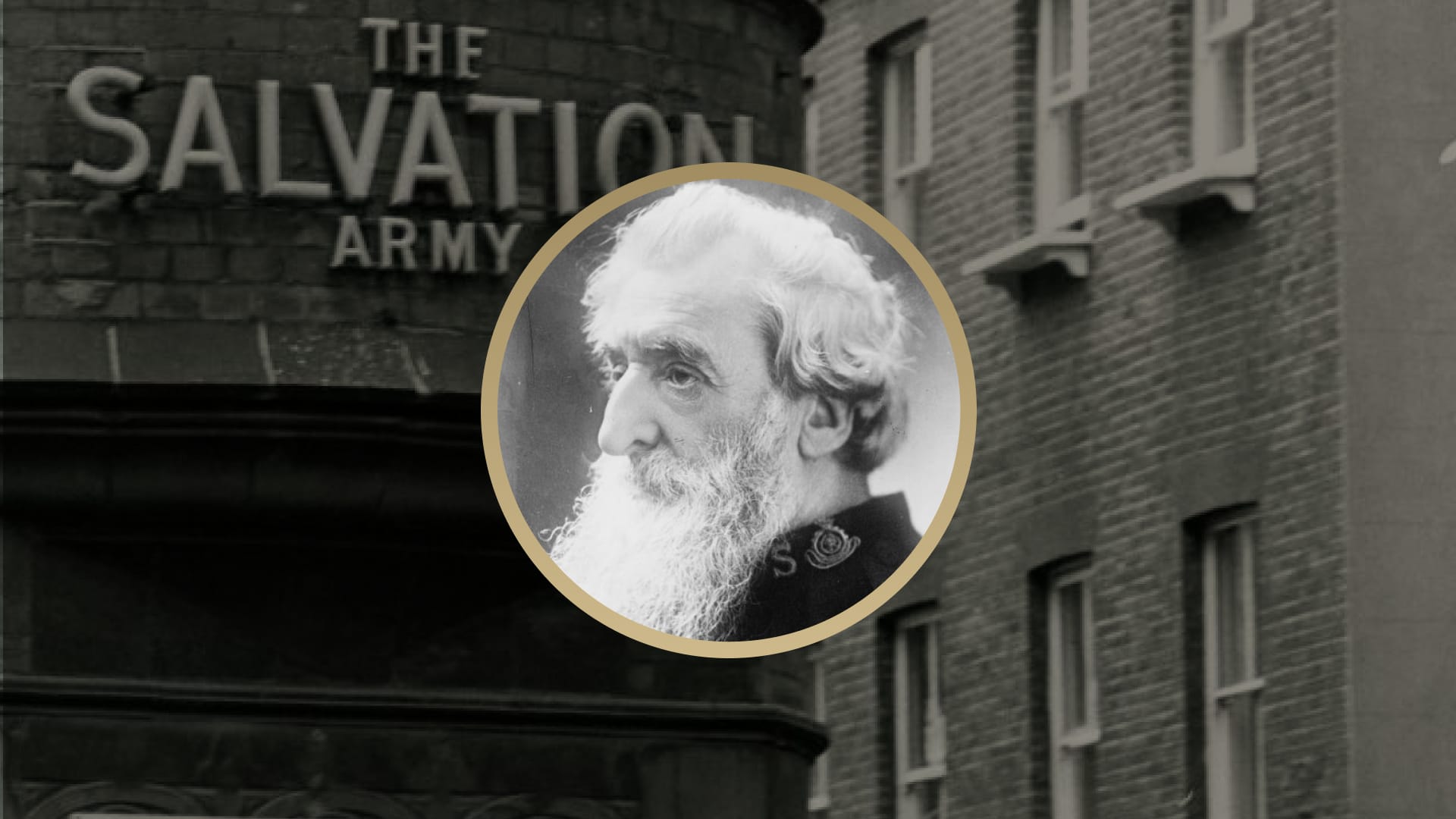
At the time that William Booth was born, England was changing fast. The Napoleonic Wars that had ripped apart Europe were finally ended. It was the dawn of the Victorian Age. Truly, the sun never set on the British Empire. British ships, British merchants and explorers, and the English language were known all around the world. Financial prosperity and global dominance were filling the sails of noble England.
But in the homeland, all was not well. The Industrial Revolution, the same social transformation that gave England her prosperity, also brought its hardships to the masses of humanity. In great cities, such as London and Bristol, poverty and squalor abounded in the crowded streets. Men, women, and even children labored hard all day for a meager few shillings. Drunkenness and immorality entrapped the people debased in their terrible conditions.
Into these miserable conditions was born William Booth on April 10, 1829. His father was a nailmaker who worked long days in a factory in Nottingham. The Booth family was poor, very poor. The father, Samuel Booth, was not even able to pay for his children to finish their schooling. Instead, he began to send his children out to early apprenticeships.
His son, William, at the age of thirteen, became an apprentice to a pawnbroker. Then, as well as now, pawnshops are notorious for their illicit trade in stolen wares. Pawnbrokers offer loans at high interest rates for those who bring in valuable personal property. A man might pawn off his gold watch, his wife’s pearl earrings, a musical instrument, or even a treasured family heirloom in order to quickly obtain much-needed cash.
Oftentimes, gamblers would bring in items, hoping to change their fortunes at the gaming table and quickly get their property back with even more money to spare! Drunkards would, in the throes of an addicted craze for temporary satisfaction, pawn off their valuables (or those of family members) for enough money to spend a seemingly pleasurable evening at the tavern. Thieves would take stolen booty to the pawnshop, pretending that they had fallen on hard times and needed to pawn off “their” valuables for quick cash.
Pawnbrokers were often dishonest men themselves. They might tell a person pawning a truly expensive gold watch that it was not really worth that much, and then inflate the watch’s value to an eventual buyer. The dealers in pawned goods would buy low and sell high, and unduly profited at the expense of others. This was the trade that William Booth was apprenticed in and learned, and he learned it well.
After two years learning the pawnshop business, the Lord God Almighty arrested the attention of young William Booth. He was invited to a Methodist chapel. He went, and there he heard the Good News of free salvation in Jesus Christ.
Instead of selfish greed, he found in Christ Jesus the free gift of grace, offered without cost to any repentant sinner. The blood of Jesus was freely offered to pay the ransom of his sinful soul. William Booth repented of his sin and put his faith and trust in Jesus Christ, the One Who offers to all men to drink of the water of life freely.
Of his conversion he wrote in his diary, “God shall have all there is of William Booth.” The teenage Booth began to share with all his friends the wonder of what he had found. Soon, he and a few of his friends began holding open air meetings in the streets and parks of Nottingham. Booth was still an apprentice, but he was eager to share with other apprentices and poor folks the glorious riches of Heaven.
The Gospel message resonated with the poor in the Nottingham slums. Booth and his friends saw eternal fruits for their labors. “For ye know the grace of our Lord Jesus Christ, that, though he was rich, yet for your sakes he became poor, that ye through his poverty might be rich” (II Corinthians 8:9).
Even in the pawnshop, William Booth tried to influence others for good. He sought to be fair in his offers of cash. He tried to turn the sinner from the error of his ways. He declined to participate in financial gain if he suspected a man was trying to pawn off stolen property.
When his apprenticeship finally ended in 1848, Booth tried in vain to find employment. He left Nottingham and went to London. He worked in a pawnshop there, as it was the trade that he knew best and one that placed him in contact with those he had come to love—the poor, struggling multitudes of the great cities.
Booth started proclaiming the riches of the Gospel in the streets of London just as he had done in Nottingham. He preached at Kennington Common, a vast park where the public gathered for events that were as varied as cricket games and public executions.
On April 10, 1852, William Booth left the pawnshop business permanently. That day was his twenty-third birthday. He took a position as a full-time preacher at Binfield Chapel in Clapham, a district in the south of London. It was during this period that he became engaged to Miss Catherine Mumford. The two had met when Miss Mumford heard Booth reading a poem against the dangers of alcohol. The two were married on June 17, 1855, and embarked in ministry together.
William and Catherine Booth opened the East London Christian Mission in 1865. At first it was called “The Christian Revival Society.” The couple provided soup for the hungry body and a presentation of the Gospel for the hungry soul. They spent many hours laboring among the destitute and despised. William Booth was stoned by street urchins, cursed by drunkards, and despised by many. But one by one, souls were transformed by the power of the Gospel.
The mission was renamed in 1878, and styled itself “The Salvation Army.” Booth designed a flag of red with a gold star in the center of the banner, sporting the words “Blood and Fire.” Detractors took this to be offensive—that the Gospel was advanced by actual blood and fire. But Booth meant the blood of Jesus and the fire of the Holy Spirit.
His methods were unusual. He styled himself as “the General” and appointed other “officers” of the “army,” as the new name indicated. He designed uniforms for his workers and taught them to march. He offered free food and lodging to those who would hear his message.
The General certainly had various character flaws and blind spots which affected the ministry of the Salvation Army. For example, Booth’s authoritarian approach caused such friends as “Gipsy” Smith and D. L. Moody to separate from him and his work. Yet, the Lord used William Booth in a mighty way to open the eyes of many people, believers and unbelievers alike, to the real, practical needs of poor people in every corner of the world where sin and misery abound.
The Salvation Army has evolved over the many years since its founding, but it cannot be denied that the ministry of bringing in the poor has transformed lives for eternity. By the time that General Booth died on August 20, 1912, at the age of eighty-three, the Salvation Army was active in fifty-eight countries around the world. Forty thousand grateful people attended his funeral, and 10,000 uniformed “soldiers” of the Salvation Army marched behind his casket to his final resting place.
Sources and Further Reference:
Hattersley, Roy. Blood and Fire: William and Catherine Booth and the Salvation Army. New York, NY: Doubleday Publishing, 2000.

 27:22
27:22