
What can a grandparent do to change the world? Actually, grandparents often have an overlooked and underappreciated role in the life of the family, as well as in the church and even the nation!
Jesus told His disciples, “Take heed that ye despise not one of these little ones; for I say unto you, That in heaven their angels do always behold the face of my Father which is in heaven” (Matthew 18:10). Sadly, too many grandparents are cut out of their grandchildren’s lives by the parents, or the grandparents cut themselves off because they consider their grandchildren an inconvenient bother that stands in the way of their own plans. Either reason for this generational separation diminishes or can destroy that which God intended for great good.
Give thanks to God for grandparents who invest their time and attention in the eternal welfare of their grandchildren!
The pages of the New Testament record for us the example of Lois, a Godly grandmother who invested heavily in the life of her grandson Timothy and reaped eternal dividends for her pious effort. She is mentioned by the Apostle Paul in the last letter he wrote. Written from a dungeon in Rome to Timothy, in the opening verses of the letter Paul called Timothy to remember the influence of his mother and grandmother.
The apostle’s letter began with, “Paul, an apostle of Jesus Christ by the will of God, according to the promise of life which is in Christ Jesus, To Timothy, my dearly beloved son: Grace, mercy, and peace, from God the Father and Christ Jesus our Lord (II Timothy 1:1–2).
Paul continued his greeting. “I thank God, whom I serve from my forefathers with pure conscience, that without ceasing I have remembrance of thee in my prayers night and day; Greatly desiring to see thee, being mindful of thy tears, that I may be filled with joy; When I call to remembrance the unfeigned faith that is in thee, which dwelt first in thy grandmother Lois, and thy mother Eunice; and I am persuaded that in thee also” (II Timothy 1:3–5).
In this poignant salutation to Timothy, Paul noted and honored Lois, Timothy’s grandmother, as the beginning of this Godly progeny. The apostle called Lois’s faith “unfeigned.” The very descriptive Greek word he used is ἀνυποκρίτου (anupokritou), which means “not hypocritical” or “unmasked.” Paul wrote of Lois that her faith was not merely a religious mask, but part of her life as a consistent whole.
Even more to this grandmother’s credit, not only was her faith unfeigned, but her daughter’s faith was sincere too. By God’s grace, Lois was able to pass along her faith to her own child and then on to her grandchild.
This family is first mentioned in chapter 16 of the Book of Acts. The year was around A.D. 50. Paul and Silas were on their second missionary journey. They were visiting the saints in Asia Minor, now present-day Turkey. According to Acts 16:1–2, “Then came he to Derbe and Lystra: and, behold, a certain disciple was there, named Timotheus, the son of a certain woman, which was a Jewess, and believed; but his father was a Greek: Which was well reported of by the brethren that were at Lystra and Iconium.”
As Paul entered the region, he heard reports of this “certain disciple.” Already, Timothy was a disciple. Furthermore, Timothy had a good report in the eyes of all the brethren of the region.
This visit was not the first time Paul had been in this region. Three years earlier, in A.D. 47, Barnabas and Paul had visited these cities on their first missionary journey. They had already toured the island of Cyprus. There, Sergius Paulus, the island’s Roman governor, had been converted to Christianity. From Cyprus, Barnabas and Paul had penetrated the heart of Asia Minor. Pushing into the Taurus Mountains, they had visited Antioch of Pisidia and preached the Gospel to the inhabitants of that city. From there, the two men traveled to Iconium, Lystra, and Derbe.
In Lystra, Paul and Barnabas had healed a lame man. The city was so pagan that the people tried to worship Paul and Barnabas! Then, before many hours had passed, the same people, stirred up by angry Jews from Iconium and Antioch of Pisidia, stoned Paul and left him for dead outside the city gate of Lystra. At that time when Paul was left for dead, according to Acts 14:20, “Howbeit, as the disciples stood round about him, he rose up, and came into the city: and the next day he departed with Barnabas to Derbe.” Who were those “disciples”?
It appears that there were some true believers already in the city of Lystra. Perhaps Lois and Eunice were among them? If so, they would have watched with their own eyes as this “martyred” apostle of the Lord stood up and walked into the city. Where did he stay? Perhaps it was in the home of Lois and Eunice that Paul learned firsthand about the unfeigned faith that was in them.
Approximately four years later, Paul returned to the very same town in which he was stoned! Meanwhile, during the interval of time, something had happened. Timothy had, in the home of Lois and Eunice, blossomed into a splendid young disciple under the influence of his Godly mother and grandmother.
What was a Jewish family doing in Turkey? As far as the record goes, there was not even a synagogue in the city of Lystra. Lois’s daughter had married a Greek man, and her grandson had not been circumcised in the manner of Abraham. These mixed marriages were a problem in the New Testament world, and the details of this one are not given in Scripture.
Regardless of her difficult circumstances, Lois purposed that she would do her best to carry on the faith in her family! In the third chapter of Paul’s final letter to Timothy, we gain another glimpse of the training Lois gave her young grandson. Paul mentioned Timothy’s upbringing again in II Timothy 3:14–15. “But continue thou in the things which thou hast learned and hast been assured of, knowing of whom thou hast learned them; And that from a child thou hast known the holy scriptures, which are able to make thee wise unto salvation through faith which is in Christ Jesus.” Paul asserted that Timothy had known the Scriptures “from a child.” The Greek word is βρέφους (brephous); it can be used of an infant, even an unborn infant.
Unborn babies can indeed hear and sometimes respond to the voices of parents, grandparents, and others (see Luke 1:41). Lois and Eunice may have read or prayed the Scriptures often to or over Timothy his whole life—in the womb, as a newborn, then a toddler, and also as a young child. Soon, Timothy would have been able to read God’s Word for himself. Paul calls the Bible here “the holy scriptures.” This is a very tender term, literally, “the sacred letters.” It is not the usual word γραφή (graphe), “the writings.” Paul could have used this more common term. But instead, he chose the particularly tender and unusual term γράμματα (grammata), “letters.”
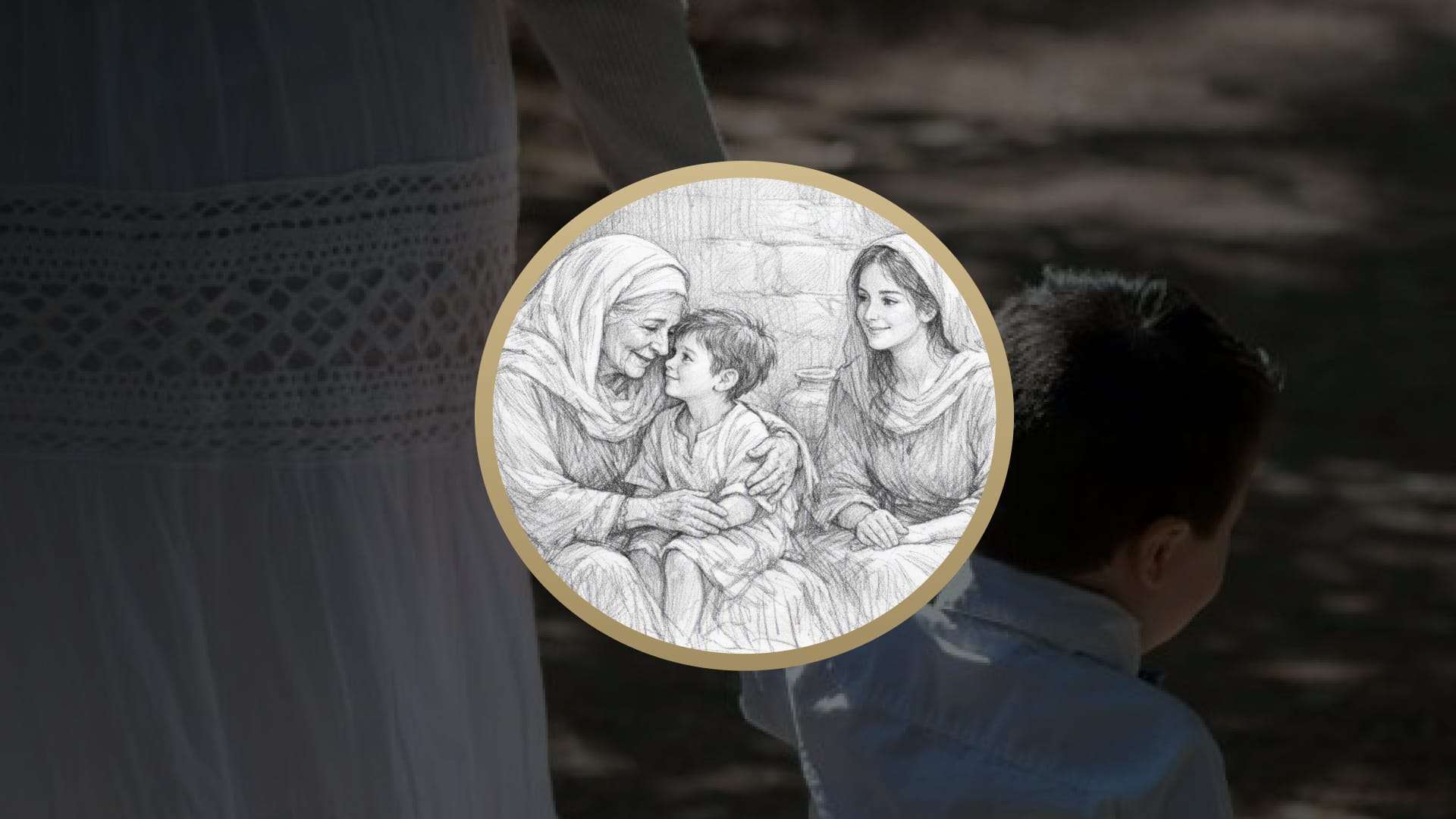
This letter seems to be reminiscent of a time in Timothy’s childhood when the hands of his grandmother and mother guided his tiny hands to trace, and read, and write the only worthy textbook available—the “sacred letters” of the Hebrew Scriptures. This was Lois’s pattern of teaching. In the absence of a Hebrew father and with paganism encroaching on all sides, Timothy’s grandmother took on the task of the instruction found in Deuteronomy 6. She taught Timothy to love the Lord his God with all his heart, with all his mind, with all his strength. She no doubt drew special encouragement from the Scripture that said “thy children’s children” (Psalm 128:6).
Lois and Eunice had taught Timothy as the Torah instructed: when they sat in the house, when they walked by the way, when they lay down, and when they rose up. Together with her own daughter Eunice, Lois guided the physical and spiritual steps of Timothy’s life and taught him to fulfill the meaning of his name, “one who honors God.”
What was the greatest possession of Lois? Her craft is not known. What she possessed is not revealed in the Scriptures, nor are her talents or abilities. The crown of glory set on this God-fearing grandmother’s head was her Godly grandson. Timothy was “well reported of by the brethren.”
Where did Timothy learn the Scriptures that so filled his heart and the hours of his meditation? Where did he learn the endurance that would carry him down the difficult road that lay ahead? He learned it on the lap of his grandmother, Lois. God honors and takes delight in the influence of grandparents who devote the best years of their lives to the next generation.